



When an offer comes in below what you researched and targeted, your instinct might be to accept it anyway or walk away entirely. Neither response has to be your only choice. Knowing how to counter a job offer, especially when it is a lowball, is exactly what separates candidates who negotiate successfully from those who leave money on the table out of uncertainty about what is possible.
A lowball offer is not a verdict on your value. It is a standard first move designed to see whether you will defend your research or fold under the pressure of having a number in front of you. This guide walks through what a lowball signals, why companies use this tactic, how to recognize when an offer truly falls short, and the specific steps to counter a job offer without losing the opportunity entirely.
Quick answer: Use your walk-away, target, and opening-ask numbers from the 3-number framework to evaluate the lowball first. Then counter with a specific, researched ask backed by evidence, not emotion. Reference your market research and ask for flexibility before accepting a number below your target.
What does a lowball job offer actually signal?
A lowball offer tells you something specific: the company wants to test whether your research and confidence are solid or whether you will accept substantially less when actual money appears on the page. It is not always hostile. Often it is procedural.
Recruiters and hiring managers operate within constraints that candidates cannot see. HR bands cap how much flexibility exists. Your hiring manager’s authorization ceiling sits well below what they might theoretically offer. A budget was set before your candidacy even existed. A lowball is frequently the company’s opening position inside those constraints, not a judgment about whether your ask was fair.
Understanding this matters because it changes how you interpret what is happening. When you receive an offer that is materially below your target number, you have learned something valuable: either the band does not reach where your research said it would, or the person delivering the offer has not yet checked with someone who can access more budget. Knowing which one applies tells you whether to counter or whether to make a decision to walk based on your predetermined walk-away number.
How do you recognize a lowball versus a genuinely constrained offer?
Not every offer below your target is a lowball designed to reset your expectations. A few signals help separate a company testing your resolve from one that has genuinely hit its ceiling.
A company with flexibility usually delivers the offer with an explanation. “I wish we had more room in this band” or “Our budget for this role maxes out at eighty-two thousand” tells you the company recognizes the gap and why it exists. A lowball tactic tends to arrive without much context beyond the number itself. The offer comes in, often faster than you expected, as if the number should stand on its own merit.
Timing matters too. Real budget ceilings tend to surface after at least one back-and-forth has already happened, because recruiters usually need to check upward before confirming their actual limits. An offer that comes in immediately, before you have had a chance to share your research or ask clarifying questions, signals the company may be testing whether you will accept without negotiating, not that they have carefully considered the constraints.
The person delivering the news also carries weight. If a recruiter says “this is our limit,” they are describing their own authorization ceiling, which Chapter 10 of the complete kit established is not necessarily the role’s real ceiling. A hiring manager or someone with visibility into the full band saying the same words carries more credibility, because they are positioned to know where the real limit sits.
Tone signals information too, though it is softer than the others. A recruiter delivering a genuinely constrained offer often sounds apologetic or regretful. A recruiter running a testing tactic tends to sound neutral or procedural. None of these signals are certain on their own. The response scripts in this guide are built to test the offer gently rather than requiring you to guess correctly before responding.
How do you evaluate a lowball using the 3-number framework?
Your walk-away, target, and opening-ask numbers exist precisely for this moment. Before deciding whether to counter, run the offer through your three benchmarks and decide whether the gap is real or tactical.
Your benchmarks themselves came from research sources: self-reported data like Glassdoor, industry surveys from sources like the Bureau of Labor Statistics, and conversations with your network. That research is your foundation for testing whether a lowball represents genuine constraints or a negotiation tactic.
Take the offer at face value first. If the company offers eighty thousand dollars in base salary, price the entire package using the method from Chapter 5: add the signing bonus if one exists, calculate the retirement match percentage at that salary level, convert paid time off to a daily rate, price benefits. The total comparable value is what matters, not the base salary in isolation.
Compare that total to your walk-away number. If the offer clears your walk-away point, the company has left room for you to negotiate without walking. This is a negotiable gap. If the offer falls below your walk-away entirely, you have learned the company cannot meet your minimum threshold as currently structured. At that point, the decision shifts from negotiation to evaluation: whether the role justifies accepting below your walk-away or whether walking is the right move.
If the offer lands between your walk-away and your target, this is exactly where Chapter 7 stress-tested you to negotiate. The recruiter’s opening move is below your target but above your floor. This gap is negotiable, and countering is not just reasonable. It is the expected next step in a standard conversation.
Why do companies lowball, and what do they hope will happen?
Understanding the mechanism behind lowball offers helps you respond strategically instead of emotionally.
A lowball works because it exploits a documented psychological pattern: when a real number sits in front of you, the fear of losing the offer entirely gets weighted far more heavily than it deserves. Chapter 1 of the complete kit described this loss-aversion mechanism in detail. The immediate, vivid discomfort of having a specific, lower number on the table tends to override the abstract, long-term cost of accepting it. A recruiter who understands this pattern knows that many candidates will accept a lowball offer because the discomfort of the moment feels more urgent than the financial math of the next five years.
A lowball also tests whether you are anchored to solid research or whether your ask was speculative. A candidate who immediately accepts a lowball offer sends the signal that the original ask had no real research behind it, just a number that sounded good. A candidate who counters with specific evidence sends the opposite signal: the original ask was researched and defensible.
From the company’s perspective, a lowball is low-risk to try. If you accept it, the company saved money without giving up anything. If you push back, the company has learned something about your resolve and can move to a second offer, still negotiating from a position of having named a number first. The tactic works often enough that it becomes standard practice, applied to nearly every candidate regardless of the quality of their research.
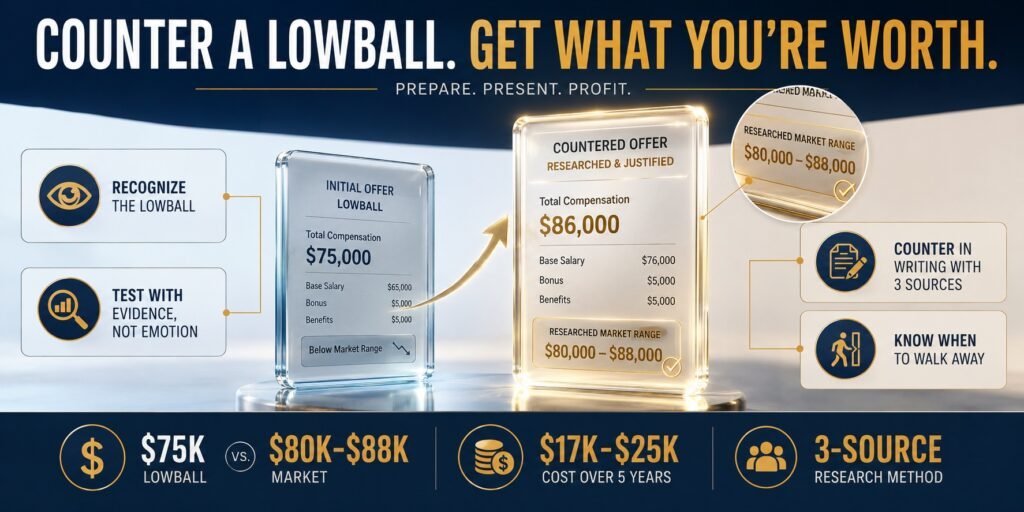
The cost of silence: A candidate who accepts a lowball offer without countering loses not just the gap in year one. If you accept seventy-five thousand dollars when your research showed the market range at eighty to eighty-eight thousand, and you stay in the role for five years, that single decision to accept without negotiating costs you approximately seventeen thousand to twenty-five thousand dollars once you factor in raises that compound on the lower base and opportunity cost at each future role that anchors to your previous salary.
How do you counter a job offer in writing?
The email response to a lowball offer does two things at once. It tests whether the offer truly reflects the company’s limit, and it re-anchors the conversation to your research.
Use this structure: acknowledge the offer, express enthusiasm, reference your research, name the gap clearly, and ask for flexibility. Here is how it lands:
“Thank you for the offer and the time you invested in this conversation. I remain genuinely excited about the role and the team. I did want to circle back on the base salary, because I want to make sure we land on a number that reflects both the market and the value I will bring to this position. My research into comparable product manager roles in this market showed a range of roughly eighty to eighty-eight thousand dollars. Given my five years of directly relevant experience, I was targeting eighty-six thousand. Your offer of eighty thousand is below that range. Is there flexibility to move closer to my research-backed target, or eighty-five thousand at minimum?”
This script accomplishes several goals. It names your research without anger, frames the counteroffer as collaborative rather than combative, leaves room for the company to move between what they offered and your ask, and gives the recruiter a graceful exit without forcing a full reversal.
The specificity matters. Do not say “I was expecting more.” Say “My research showed eighty to eighty-eight, and I was targeting eighty-six.” The research reference signals that your ask is not arbitrary. It is backed by data the company can verify if they choose to.
| What you say | What the recruiter hears |
|---|---|
| “I was hoping for more” | No research behind the original ask; they are negotiating with emotion, not data. We can wait them out. |
| “My research showed eighty to eighty-eight; I was targeting eighty-six” | This candidate did the work. Their ask is defensible. We should check upward and see if there is room to move. |
| “This is below market” | Vague claim without evidence. Easy to dismiss or defend against. |
| “Three independent sources showed the market at eighty to eighty-eight” | Specific, verifiable, hard to argue against without providing their own source data. |
What do you do if the recruiter says the lowball is final?
Not every “this is our best offer” is a true final number. Chapter 14 of the complete kit walks through how to test the claim without being confrontational. The script is simple and specific:
“I appreciate the clarity on the base salary. Given the value I would bring to this role, is there any flexibility at all, even a smaller adjustment, or is this number truly firm?”
This response gives the recruiter a graceful way to move slightly without admitting their original offer was wrong. The key phrase, “even a smaller adjustment,” acknowledges limited flexibility without demanding a full reversal.
If the recruiter confirms the number is genuinely firm after this direct question, take that at face value rather than continuing to push, since a recruiter who has now been asked directly and still holds the line has given you real information. At that point, shift to non-monetary items from Chapter 4: signing bonus, start date, remote flexibility, additional PTO, flexible schedule, or professional development budget.
Jamal, the example from Chapter 14, followed exactly this pattern. His counteroffer was countered with “this is our best and final,” a number of one hundred one thousand. Rather than testing the salary claim a third time, he shifted immediately to a signing bonus: “That works well. Given the gap is small, would a two-thousand-dollar signing bonus be possible to help close it?” The recruiter agreed within the hour. His total package cleared his target, even though the base salary technically fell short.
How do you counter a job offer using your opening ask?
When you counter a lowball offer, do not open with your target number. Open with your opening ask from Chapter 7: five to ten percent above your target. This gives the conversation room to move back toward your target through a process that feels like normal negotiation rather than a compromise you never intended.
If your target is eighty-six thousand and your opening ask is ninety-three thousand, and the company lowballed at eighty thousand, your counteroffer should land somewhere near eighty-eight to ninety thousand. Not your target directly. This leaves room for the company to move again before the conversation settles.
The reasoning is structural: negotiations run on an unspoken assumption that both sides will move at least once. If you counter at exactly your target after receiving a lowball, the only place the conversation can go from there is down. Opening above your target means you have planned room to make a concession that still lands you where you wanted to be.
When should you walk away instead of countering?
After testing a lowball offer once with the scripts in this guide, a genuinely firm answer deserves to be respected rather than pushed repeatedly.
The signal to keep negotiating: the recruiter’s second reply offers a specific, documented reason for the lowball (a band ceiling, a hard budget cap) and moves at least somewhat from their first position. That movement, combined with a specific reason, signals the door is still open.
The signal to stop negotiating: the recruiter repeats the same number a second time, delivers it the same way, with the same lack of explanation or movement. At that point, continuing to push reads as not listening rather than determined negotiating. Compare the offer against your walk-away number and make your go-or-no-go decision based on what you learn, not on the hope that a third ask will produce movement that the first two did not generate.
This connects directly back to Chapter 7’s walk-away framework. Your walk-away number was set in advance, in a calm moment, precisely because you will not be calm when the pressure is on. Reading it back to yourself in this moment is not a negotiation tactic. It is letting your earlier, clearer-headed research make the decision your in-the-moment self is least equipped to make well.
| Situation | What to do |
|---|---|
| Lowball with specific reason (budget cap, band ceiling) and movement on second ask | Counter the gap again, or shift to non-monetary items. Door is open. |
| Lowball with no explanation; same number on second ask; no movement | Compare to walk-away. Make go/no-go decision. Pushing further damages the relationship. |
| Lowball below your walk-away entirely, no explanation | Ask one clarifying question about whether flexibility exists. If answer is no, you have your decision: walk or negotiate signing bonus/benefits. Do not push the base salary a third time. |
What mistakes should you avoid when countering a lowball?
A few reactions make a lowball harder to recover from, not easier.
Do not accept immediately out of relief that the tension is over. The urge to end an uncomfortable conversation is real, but the loss-aversion mechanism from Chapter 1 is working against you precisely in this moment. Do not escalate to anger or ultimatums either, because Chapter 12 established that frustration tends to produce defensiveness rather than movement, even when your ask was entirely reasonable. Do not go silent, letting an awkward pause do the negotiating for you. Silence without a following question or statement reads as having nothing left to say, not as quiet leverage.
A subtler mistake: over-explaining your counteroffer with three additional reasons after the lowball, hoping enough justification will wear down a firm answer. Chapter 8 already established that a strong case rests on one or two specific, well-chosen pieces of evidence, not a long list. Restate your research-backed number calmly, once. That reads as more confident than burying it under a growing pile of justifications that can sound like pleading.
Do not let the lowball make you doubt your research. If three sources converged on your range, and the offer falls outside it, the data does not change because the company offered less. Your research was sound. The offer is simply a starting position in a negotiation, not a verdict on whether your target was reasonable.
What comes next after you counter a job offer?
After you counter a job offer, an actual back-and-forth begins. The 3-number framework from Chapter 7 still governs your decision-making at each stage. Your opening ask strategy, your target ceiling, and your walk-away floor do not change. The email structure from Chapter 8 applies to each response. You have now given the company your research on the record. They cannot claim later they did not know what you were targeting.
Each time they counter, run the full package through the total-compensation calculator from Chapter 5. Do not get distracted by a single component. Base salary is part of the picture, not the whole picture. If they move on salary but add a signing bonus or improve the retirement match, the total comparable value might already exceed your target even though the base salary alone looks like it fell short.
Keep track of where the conversation is landing after each exchange. If the company moves once and then holds firm on a second ask, you have learned something real about their actual ceiling. If they keep moving, there is more room to work with. The pattern of movement, not just the single number in front of you, tells you whether to keep negotiating or make your decision.
One final point from Chapter 6: your research did not end when the interview finished. If the company’s offer reveals they pay significantly below market for the role, that information changes the calculus of whether you want to work there at all, regardless of whether you can negotiate them to market rate. An employer who anchors consistently below market is signaling something about their budget discipline and respect for competitive salaries. Use that information when deciding whether to continue or walk away.
Recap: A lowball offer tests your research and resolve, not your value. Evaluate it against your walk-away, target, and opening-ask numbers using the 3-number framework. Counter with specific, researched evidence and ask for flexibility. If the company holds firm after you have tested once, shift to non-monetary items or make your walk-away decision. Never accept the first offer out of relief or fear of losing it.
Frequently asked questions about how to counter a job offer
Can I counter a lowball by email, or should I ask for a call?
Email is better for your negotiation. You have time to reference your research, construct your response carefully, and create a written record. A call puts you under time pressure, which is exactly the moment when loss aversion clouds your thinking most heavily. If the recruiter pushes for an immediate verbal response, use the buy-time script from Chapter 2: “I want to give this the consideration it deserves. Can I follow up with you in writing by end of business tomorrow?” Most recruiters will agree, because it costs them nothing to wait a day. If someone genuinely will not let you off the call without a number, give your researched counter verbally, then send a follow-up email that restates the same figure in writing within the hour. That written confirmation is what actually protects you later. Email also has a quieter advantage: it gives you room to have a partner, mentor, or the scripts in this kit check your wording before it goes out, which a live call never allows.
What if the lowball comes in during a call and I was not expecting it?
Use the buy-time script immediately: “I want to think through this carefully. Let me review my research and get back to you in writing by tomorrow morning.” You do not owe them a reason beyond that. You have just bought yourself time to run the numbers against your benchmarks, gather your thoughts, and draft a response when you are calm instead of caught off guard. Write down the exact number and any conditions they mentioned the moment the call ends, before your memory of the details starts to slide. Silence on the call while you say this is fine. You do not need to fill it with small talk or an apology for asking for time. A short pause reads as someone who takes the decision seriously, not as someone stalling.
Should I mention competing offers when I counter a lowball?
Only if you have one. Do not invent leverage you do not have. Some companies will ask to see the competing offer in writing, and getting caught fabricating one ends the negotiation and the relationship on the spot. If you have a competing offer that landed higher, mentioning it is useful context: “I have another offer on the table at eighty-four thousand, and based on my research, I was targeting eighty-six. Can we work closer to that range?” Lead with your research number, not the other offer, so the conversation stays about market value rather than turning into a bidding war. If you do not have a competing offer, your market research is your evidence. That is plenty. Companies negotiate against well-documented research all the time; they do not require a rival offer to take your counter seriously.
What if the company says my research is wrong?
Ask them to share their data. “I am confident in my three sources. I would be interested to see where your range comes from, because I may have missed something.” Most companies cannot point to specific market research that contradicts you; the claim is usually a negotiating reflex, not a documented position. If they can point to a real source, compare it to yours: check the date, the location, the seniority level, and whether it matches your specific role before deciding whose number is more accurate. Sometimes the real issue is not that your research is wrong, it is that the role sits in an internal pay band the company cannot move past regardless of market data. That is worth asking about directly. Either way, do not let a company dismiss your research without asking them to back up their dismissal with evidence of their own.
How much should I counter for if the lowball is really far below my research?
Counter with your opening ask from Chapter 7: five to ten percent above your target. If your target is eighty-six and your opening ask is ninety-three, open with ninety-three, even though the lowball makes that number feel bigger than it should. Do not anchor to the lowball by saying “you offered eighty, I want eighty-five.” That framing treats their number as the starting point of the conversation, which is exactly what a lowball is designed to do. Instead, anchor to your research: “My research showed eighty to eighty-eight, and I was targeting eighty-six. I would like to counter at eighty-eight.” The gap between eighty-eight and eighty is still substantial. You have not accepted the lowball’s anchor. You have reestablished your own, and you have done it calmly, without accusing them of lowballing you, which keeps the conversation productive.
What if the lowball comes with a written offer letter and they want an answer in two days?
Use the buy-time script from Chapter 2 immediately, in writing: “Thank you for the offer letter. I want to review it carefully and respond thoughtfully by end of week. Is Thursday morning okay?” Most companies will agree, because a real offer they want you to accept is not going to fall apart over three extra days. Do not sign or formally accept anything while you are under time pressure. A tight deadline is often a tactic to prevent you from taking time to think, not a genuine business constraint. Push back on the timeline as part of your response to the lowball itself. If they refuse to move the date at all, that refusal is itself useful information about how this company operates, and worth weighing alongside the number when you decide whether to counter or walk.
Should I walk away from a lowball, or is countering always worth trying?
Counter if the lowball lands between your walk-away number and your target. That gap is negotiable, and the company may move once you have tested the offer with a real counter instead of accepting on the first pass. Walk if the lowball falls below your walk-away number entirely, unless the role includes something outside base salary, like equity, remote flexibility, or a faster path to promotion, that genuinely changes your math. Even then, counter once before deciding: you learn the company cannot meet your minimum threshold with their current offer structure only after you have actually tested it, not before. Countering a salary below your walk-away with no intention of accepting anything close to it wastes both sides’ time and risks the relationship for a number you never wanted to accept anyway.
To negotiate effectively through the entire salary conversation, from interview through offer and counteroffer, use the salary negotiation calculator to build your three working numbers from your market research, consult how to write a salary negotiation email when you are ready to formalize your counter, and reference how much can you negotiate salary to understand your room to move at each stage. The complete negotiation kit covers every decision point from interview to accepted offer.
RELATED POSTS
View all


Salary Negotiation Letter Sample: What Should Yours Say?
August 7, 2026 | by The Raise Plan Team

Salary Negotiation for Women: What Actually Works?
August 14, 2026 | by The Raise Plan Team