



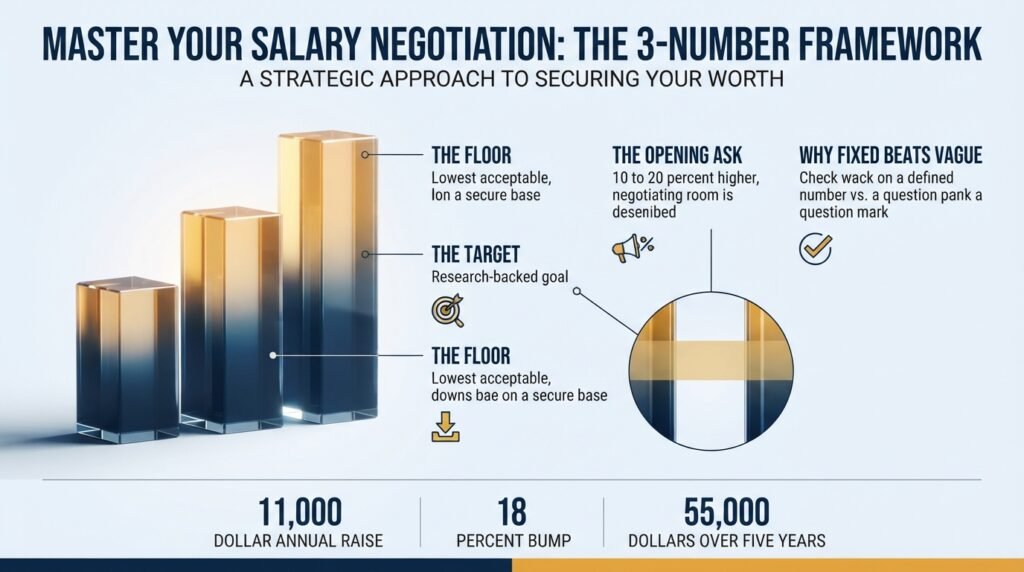
How to negotiate a raise comes down to knowing your numbers before you know your words. Before you walk into your manager’s office, you’ll need three: your floor (lowest you’d accept), your target (realistic expectation), and your opening ask (10-20% higher to leave negotiating room). The script can wait. The math comes first.
When should you ask for a raise?
The best time to ask for a raise is right after something concrete: a project shipped, a quarter closed, an expanded role formalized. You can also ask during annual review season, or when the company announces strong financials. Avoid the obvious bad windows: layoffs, missed targets, restructures, or when your boss is visibly stressed.
If your company has a formal review cycle (January, September, or whenever), approach your manager 6-8 weeks before so they can budget and advocate internally. A Tuesday or Wednesday morning beats Friday afternoon. The timing matters because your ask becomes something they need to think about and plan for, not react to.
How to calculate your number
Start with Glassdoor Salary, PayScale, or the Bureau of Labor Statistics. Enter your title, years of experience, and city. You’re looking for the range, specifically the 50th-60th percentile if you’re meeting expectations, higher if you’re outperforming. For deeper research, check out our guide to salary market research for techniques to verify these ranges in your industry.
Then layer in your personal situation. How much has your cost of living gone up since you were hired? What raises have you received? (If none in 2+ years, you’re typically owed 5-10% to catch up to inflation alone.)
Use the Raise Plan salary calculator to work backward from your target number. It shows you what that annual figure means monthly, and factors in bonuses and equity so you’re not caught off guard when you talk benefits. Write the three numbers down and say your opening ask out loud until it feels natural, not rehearsed.
What to say when you ask
Your pitch has two parts: context and the ask.
Context is 2-3 sentences of why you deserve this right now. Not personal need (“I have student loans”), business value. “I led the Q2 product launch that drove 18% revenue growth” or “I expanded my role to train the junior team, freeing up the engineering manager for strategy.”
Then: “Based on my research of market rates for this role in our area, and given my contributions, I’d like to request a raise to [your opening number].”
Stop. Don’t fill the silence. They’ll say yes, they’ll negotiate, or they’ll need time to think. All normal.
If they push back, stay on the facts: “What would need to happen for a raise to be possible?” A “budget freeze” answer means you ask when it thaws. “Hit these metrics” means you write down the metrics and set a date to check. If it’s “wait for annual review,” put it on both calendars and close with: “Great. Let’s schedule a follow-up for [date] to discuss this. Can you do [specific date]?
What if they say no?
No isn’t the end. Understand what it means first. Budget constraints are different from “you’re not ready yet.” Real budget constraints are hard to move. Performance gaps have solutions.
If it’s a performance issue: “What specifically should I accomplish? When can we talk again?” Then do it, document it, and ask again when you’ve delivered.
If it’s a budget freeze: “When do you expect the budget situation to change?” and then follow up at that time.
If a raise isn’t possible, negotiate non-monetary. Extra PTO (almost always costs them nothing), flexible schedule, professional development budget, a title change that positions you for higher pay next time. Get it in writing via email. Vague promises don’t stick.
How is asking for a raise different from negotiating a new job offer?
Everything hinges on power dynamics. With a new job offer, the company spent time hiring you: they’re committed and motivated to close. You have leverage. With your current employer asking for a raise, the dynamic flips. They know your cost, and they can hire someone cheaper or leave the budget alone. That’s why asking for a raise feels riskier than negotiating an external offer. It actually is.
This is also why your pitch when requesting a raise focuses on documentation of impact, not on entitlement. Your boss knows your work already. You’re asking them to spend more budget on a known asset when that money could go elsewhere. Frame it as a business decision (market rates, your contributions, retention value), not an emotional one. For contrast, see how negotiating a raise for a promotion works differently, you might have more leverage there because you’re taking on a new level of responsibility.
Common mistakes when asking for a raise
| Mistake | Why It Fails | Fix |
|---|---|---|
| Asking without a number | “I’d like a raise” is vague and invites a lowball offer. | Anchor with a specific figure. They negotiate down from there, not up from zero. |
| Leading with personal need | Student loans, rent, childcare, your boss doesn’t care about your life. They care about business value. | Lead with impact on the company instead. What did you do that made money or saved time? |
| Not practicing | Fumble a tough question and you lose all credibility. | Record yourself. Talk to a friend. Practice until the pitch lands naturally. |
| Accepting vague promises | “We’ll revisit in six months” means nothing without a calendar date. | Force it into writing. “So we’ll schedule this on [date]. Correct?” Backtracking becomes visible. |
| Using feelings instead of data | You might deserve a raise. The market doesn’t care what you feel you deserve. | Research actual numbers from actual companies. Use data, not emotion. |
Industry variations
Startups: Tighter budgets, less process. Ask after a funding round closes or revenue milestone hits. Equity or future bonus potential often matters more than immediate salary. Emphasize business value relentlessly.
Government roles: Pay is locked to bands, but you can move up within them. Check your agency’s pay tables first. You might already qualify for a higher level by role or certification. Your pitch shifts from “I deserve more” to “I qualify for the next band because I’ve completed X training or taken on Y responsibilities.”
Non-profits: Margins are thin. Raises are the hardest sell. If the budget really doesn’t exist, ask for professional development funds, conference attendance, or flexibility (which non-profit staff rarely get). Frame it around mission impact: “Growing in X skill lets me do Y, which directly impacts our outcomes.”
Real example: from $62,000 to $73,000
Priya was a marketing manager earning $62,000. Two years in the role, no raise yet. When she finally decided to ask, she did the homework first:
Glassdoor showed marketing managers at similar companies in her city earning $68,000-$74,000. Her company had just posted record Q2 revenue. She’d led the product launch campaign that generated 40% of it.
Her floor: $67,000 (cost of living catch-up). Target: $70,000 (50th percentile for her role and experience). Opening ask: $76,000 (negotiating room).
After a quarterly all-hands, she scheduled time with her manager. “I wanted to discuss my compensation. Since I joined, I’ve led the product launch campaign and two successful feature marketing cycles. That launch alone drove over $2 million in Q2 revenue. Based on market research for marketing manager roles in our area, and the value I’ve contributed, I’d like to request a raise to $76,000.”
They negotiated her down to $73,000. She accepted an $11,000 annual raise, an 18% bump. The company felt it got a deal (they’d budgeted up to $74,000 for external candidates). Priya hit her target with room left.
The gap between not asking and asking: $11,000 per year. $55,000 over five years. Small hesitation, large math.
What to do if they keep saying no
You have two paths. Path one: internal commitment. Accept the no, thank them for context, set a calendar reminder for 5-6 months out when you’ll ask again. Document wins between now and then so you have fresh proof points. Don’t make them bring it up. You own the follow-up.
Path two: external options. If you’ve heard no twice or the timeline keeps pushing back, start interviewing elsewhere. You don’t have to take an offer, but recruiting conversations give you market data. Sometimes a real competing offer is what gets your current employer to take you seriously. Be careful if they counter-offer. Check whether the money increase is real and permanent, or just a retention move. If their counter is still below market and their reason was budget, that tells you something.
Combine this data: the number they’re offering, the reason they gave, and how quickly they moved. That’s your signal for whether to stay and try again in a year, or start fresh somewhere else. For comparison, review the full guide to salary negotiation, which covers the broader context of when and how to advocate for yourself across your entire career.
FAQ: Asking for a raise
How do you negotiate a raise?
Research your market value using Glassdoor Salary, PayScale, or the Bureau of Labor Statistics. Calculate three numbers: your floor (lowest acceptable), target (realistic expectation), and opening ask (10-20% higher). Practice your pitch, which should include two parts: context (why you deserve it now, based on business impact) and the ask (specific number based on market research). Lead with “Based on my research of market rates for this role in our area, and given my contributions, I’d like to request a raise to [opening number].” Stop and let them respond. If they negotiate, stay on the facts and get any agreements in writing via email.
How much of a raise should I ask for?
Start by researching market rates for your role and experience level. Aim for the 50th-60th percentile of that range if you’re meeting expectations, higher if you’re outperforming. Factor in cost-of-living increases since you were hired. A typical healthy raise is 3-5% annually, but if you haven’t had one in 2+ years, you’re owed a larger catch-up.
What if my company says the budget is frozen?
Budget freezes are temporary. Ask when the budget situation improves and set a specific date to follow up. In the meantime, negotiate non-monetary benefits: extra PTO, flexible schedule, professional development funds, or a title change that positions you better for the next raise. Get it in writing.
Should I mention competing offers?
Mentioning a competing offer is powerful leverage but risky. Use it only if: (a) you have a real written offer in hand, (b) you’re actually willing to take it if they don’t match it, and (c) you’re prepared to leave. A bluffed offer will backfire. If you do have a real competing offer, frame it as a question: “I’ve been approached about another opportunity. Before I respond, I wanted to check if a raise to [number] would be possible here.”
What’s the right time to ask, performance review or separately?
Either works, but separate timing often works better. Ask 6-8 weeks before a formal review so your manager can advocate for you internally and build a budget case. You’re giving them time to plan, not reacting to a surprise in the meeting.
How do I handle it if they say yes?
Get the details in writing via email the same day: the new salary amount, the effective date, and any other terms (bonus structure, benefits changes). A verbal yes followed by email confirmation is standard. Don’t accept vague language like “we’ll figure it out in payroll.” Pin down the numbers.
RELATED POSTS
View all


Salary Negotiation for Promotion: What Scripts Actually Work?
August 7, 2026 | by The Raise Plan Team