Introduce Yourself in an Interview: What Should You Say?
August 21, 2026 | by The Raise Plan Team
When you walk into an interview, the first words out of your mouth set the entire tone for what comes next. The hiring manager or recruiter is not just listening for what you have done. They are gauging whether you understand the role, whether you can articulate value clearly under pressure, and whether you are someone they want to work alongside for hours every day. Getting your self-introduction right matters because it is your opening move in a conversation that will eventually determine whether you have leverage to negotiate later. This guide walks you through exactly what belongs in a strong introduce yourself interview answer so that you open with authority, not anxiety.
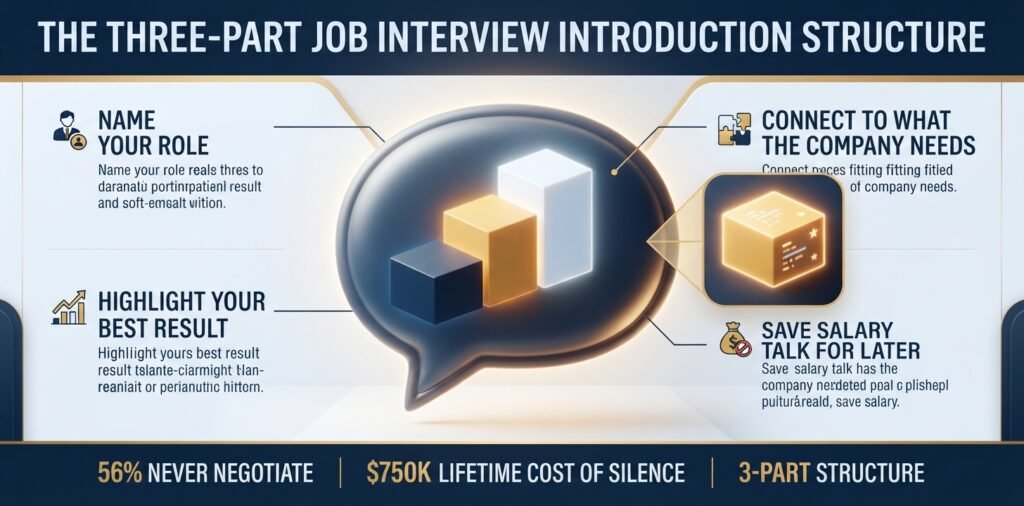
Quick answer: Introduce yourself by naming your role, highlighting the specific result that is most relevant to this job, and connecting directly to what the company needs. Focus on evidence of past wins, not your feelings or fears about the opportunity. Save salary talk for later stages. Finish with a forward-looking question that shows you researched the company.
Why does your introduce yourself interview answer matter this much?
The opening seconds of an interview carry disproportionate weight. Hiring research published by the Society for Human Resource Management consistently finds that interviewers form strong first impressions within the opening minutes and spend much of the remaining conversation confirming those impressions rather than revising them. This means your introduction is not just part of the interview. It is the foundation everything else sits on.
Here is what makes this relevant to salary negotiation and career leverage. A weak self-introduction signals three things to the hiring manager at once: uncertainty about your own value, lack of preparation, and possibly anxiety about the role itself. Any of those signals makes you a weaker negotiator later. A hiring manager who believes you are uncertain about your value will anchor their first offer lower, predicting you will not push back hard. They are right to predict that. A candidate who cannot explain their own wins clearly in the first minute probably will not explain their market value clearly when an offer arrives either.
By contrast, an introduction that leads with specific results and clear relevance to the role sends three different signals: you know exactly what you bring, you have done your research, and you are someone they are lucky to talk to, not someone who is lucky to get the interview. This framing changes the entire negotiation dynamic that comes later. A hiring manager who hears confidence backed by evidence in the opening 60 seconds starts the salary conversation from a different baseline assumption about your range and your willingness to negotiate.
The cost of silence: Across all interview stages, from the opening introduction through the final offer, 56 percent of professionals never negotiate at all. The financial compound cost of that silence is approximately 750,000 dollars over a career. The decision to negotiate or not is usually made long before the offer lands, based on signals from the interview itself. How you introduce yourself determines whether the hiring manager believes you are the type of person who will negotiate later or the type who will accept whatever comes.
What’s the three-part structure behind a strong introduce yourself interview answer?
A strong self-introduction has three distinct parts, each one serving a specific purpose. Skip any of them and your introduction feels incomplete. Land all three and you have established authority before the first real interview question.
The first part is your context: your current or most recent role and the industry or function that defines your expertise. This is not a listing of job titles. It is answering the question “what world do you come from, and why does that matter here.” For a financial analyst interviewing for a senior analyst role at a different company, this might sound like “I have spent the past four years in financial analysis at a mid-sized tech company, where I built forecasting models for budget planning.” For a nonprofit program director interviewing for a larger nonprofit role, it is “I have spent six years running educational programs for a 50-person nonprofit, focused on serving rural communities.” The context answers the hidden question: do you understand the basic language and constraints of this role?
The second part is your proof: the specific result or achievement that is most directly relevant to the job you are applying for. This is where most candidates go wrong. Instead of connecting their experience to this specific role, they list accomplishments in chronological order or tell you everything impressive they have ever done. A strong introduction picks one result, not five. The result you pick should be something the hiring manager will need to do or oversee in this job. If you are interviewing for a customer success role focused on retention, your proof is not “I increased sales by 15 percent.” It is “I reduced customer churn by 22 percent by implementing a proactive outreach program.” If you are interviewing for a project manager role, your proof is “I led a team of six through a product launch that shipped two weeks early and under budget.” You are not bragging. You are showing the hiring manager exactly the kind of result they hired someone to produce.
The third part is your bridge: a sentence or two that connects your background and proof to what this company needs. This is the part that shows you have done your research and that you are not giving the same introduction to every company. It does not require you to know the company’s entire business plan. It requires you to know what problem this role is supposed to solve. If the job description mentions scaling customer support, your bridge mentions that you have scaled teams. If the posting emphasizes profitability, your bridge references your track record of managing budgets or improving margins. A bridge sounds like “I am excited about this role because scaling is exactly what I have done successfully before, and I can see that is what you need here as your company grows.”
What does a weak introduce yourself interview answer sound like next to a strong one?
What
Weak introduction
Strong introduction
Setup
You have five years of experience as a project manager at a consulting firm. You are interviewing for a senior project manager role at a healthcare company.
Same background and role.
The script
“Hi, my name is Alex. I have been working in project management for five years at a consulting firm. I have managed a lot of different projects, worked with many clients, and really enjoyed the variety. I am excited to bring my project management skills to a healthcare setting because I think healthcare is important and I want to make a difference.”
“I have spent five years in project management at a consulting firm, where I led cross-functional teams through complex, multi-phase client engagements. The result I am most proud of is taking over a program that was three weeks behind and 12 percent over budget, and delivering it on time and 8 percent under. I know healthcare projects have unique regulatory and compliance layers that consulting does not, and that is what appeals to me about this role. I have the discipline from managing complex constraints at scale, and I am ready to apply that directly to your organization’s needs.”
Why it matters
No specific proof of impact. Uses “a lot of” and “many” instead of numbers. The bridge is generic (every candidate says they want to make a difference). Does not show research into the healthcare company or its specific needs. Relies on enthusiasm instead of evidence. Ends without demonstrating understanding of healthcare constraints.
Specific numbers (five years, cross-functional, three weeks behind, 12 percent over, 8 percent under) create credibility. The proof shows the hiring manager the exact type of problem-solving they need. The bridge demonstrates research (acknowledges healthcare-specific constraints) and connects past success to their future need. No filler words. No generic enthusiasm. Ends with confidence, not hope.
What mistakes do candidates make introducing themselves in interviews?
Most candidates make one of three predictable errors when they introduce themselves. Knowing what these are helps you avoid them.
Leading with feelings instead of facts is the first mistake. “I have always been passionate about customer service” or “I am really excited about this opportunity” tell the hiring manager nothing about your actual ability. A feeling is not evidence. By contrast, “I have spent three years building customer support processes that reduced response time from 48 hours to 4 hours” is evidence. Feelings do not move negotiations. Facts do.
Vague language in place of specifics is the second common error. “I have done a lot of work in sales” or “I managed several projects” leaves the hiring manager guessing about scale. Does “a lot” mean 5 or 50? Does “several” mean 3 or 30? By contrast, “I managed seven product launches and consistently delivered within a 5 percent variance of budget” is clear. Numbers stick. Vague words disappear.
Making your introduction all about you instead of about them is the third mistake. “I would love to learn new skills and grow my career here” centers your development, not their need. A strong introduction centers their problem and your track record of solving it. “Your team is scaling customer acquisition, and I have direct experience scaling acquisition funnels that improved conversion by 18 percent” puts the focus on what they need and what you can deliver.
How do you craft your own three-part introduction?
Start by answering three separate questions in writing. Do not overthink. Write two to three sentences for each.
Question 1: What is your context? Write out your current or most recent role, the industry, and the key type of work you do. Example: “I am a marketing manager at a B2B software company. I focus on demand generation and lead nurturing for enterprise accounts.”
Question 2: What is your proof? Write down one specific result that is relevant to the job you are applying for now. Include numbers. Example: “I built a webinar nurture sequence that increased qualified leads by 26 percent and reduced cost per acquisition by 19 percent.” Do not list three results. Pick one that matches the job description.
Question 3: What is your bridge? Write one sentence that connects your background to what this company needs. Look at the job description and ask what problem this role is supposed to solve. Example: “I know you are building your enterprise sales team, and scaling demand generation at that level is exactly where I have proven success.”
Now string them together into one fluid paragraph. Read it aloud. Time it. A strong introduction takes 45 to 60 seconds to deliver. If it takes more than 90 seconds, you have added too much. Cut the details that sound impressive but are not directly relevant to this specific job.
What should you do if the interviewer interrupts your introduction?
Some interviewers will let you finish your 45-second introduction. Others will jump in after 20 seconds with a follow-up question. Both are fine. If an interviewer interrupts, do not treat it as a rejection of your introduction. Treat it as them asking for a specific detail earlier than you planned to deliver it.
If the interruption is a question about one of your results (“You said you improved retention by 22 percent? How did you do that?”), answer the specific question directly and keep your answer to two sentences. Do not go back to the beginning and start your introduction over. They interrupted because they wanted more detail on that exact point, not because they did not want to hear the rest.
If the interruption is a reframing (“So you have a lot of project management experience. What appeals to you about healthcare?”), they are asking you to jump to your bridge earlier. Skip ahead. Answer their question about why healthcare appeals to you, ground it in your specific experience, and leave room for them to ask about your full background if they want it.
How does your introduce yourself interview answer change when you’re switching careers?
Career changers sometimes hesitate to deliver a strong introduction because they worry their background does not directly match the job. This worry is understandable but it flips the wrong way. Your job in the introduction is not to pretend you have been doing this job forever. Your job is to show the hiring manager that you have the underlying skills that transfer, and that you understand the specific challenges of this new field.
The structure stays the same. Context, proof, bridge. What changes is the bridge.
Instead of “I have 10 years of operations experience in technology, and I know scaling is your challenge,” you say “I have 10 years of operations experience in technology, where I have repeatedly solved supply chain and logistics challenges at scale. I know healthcare logistics have specific regulations I am learning about, and my operations background gives me the foundation to master those constraints quickly.” You are naming that you are new to the industry. You are not hiding it. You are showing the hiring manager that your underlying skill set (supply chain, logistics, managing constraints) transfers directly, and that you are aware of what you need to learn.
A career changer who leads with their transferable skills and acknowledges what is new comes across as confident and honest. A career changer who tries to pretend their background is more relevant than it is comes across as either naive or dishonest. Hiring managers prefer honest.
When during the interview process should you use your introduce yourself interview answer?
Where you deliver your introduction matters. Most candidates experience a job interview as a single conversation. In reality, an interview is a series of different stages, each one with different dynamics and different goals.
The phone screen or initial recruiter call is Stage 1. Your introduction here is shorter and lighter. You are confirming basic fit, not making your full case. A phone screen introduction might be 30 seconds: “I am a marketing manager with eight years of experience in SaaS demand generation, most recently focused on enterprise account expansion, which is exactly the type of role you have open.”
The hiring manager interview or first substantive conversation with the team is Stage 2. This is where your full three-part introduction lands with the most impact. The hiring manager has already decided you passed the basic screen. Now they want to know how you think, whether you understand their specific challenges, and whether you are someone they want to work with. Your full 45 to 60-second introduction sets the tone for that entire conversation.
Later-stage interviews with peers or senior leaders are Stage 3 and beyond. By this point, the hiring team already knows your background. You do not repeat your full introduction with every interviewer. Instead, you adapt it. With a peer on your potential team, you might emphasize your collaborative approach to one of your results. With a senior leader, you might emphasize the scale or the business impact. You are not making a new introduction. You are highlighting the aspect of your introduction that is most relevant to the person you are talking to.
The reason this staging matters is that it sets expectations for what comes next. If you deliver your strong, evidence-backed introduction early in the process, you establish yourself as a serious candidate with clear value. You make it harder for the hiring manager to anchor low when the offer arrives. If you deliver a weak introduction early and try to add evidence later, you are working against the initial impression.
How does your introduce yourself interview answer connect to salary negotiation?
Your introduction is not where you discuss salary. It is where you establish the baseline that makes salary negotiation possible later.
A candidate with a weak introduction, when asked about salary expectations before an offer exists, will often quote a low number because they have not made a clear case for their value. A candidate with a strong introduction, by contrast, has already established why they are worth more. When the recruiter asks “What are you looking for in salary,” the candidate who led with clear results can say “Based on the market range for this role and my experience level, I am looking at 92,000 to 100,000” and the hiring manager hears that as backed by research and confidence, not as a guess.
The scripts and strategies in the complete salary negotiation kit cover what to say when salary expectations come up early. What matters for your introduction is that you have already signaled, in the first 60 seconds, that you are not someone who will accept whatever offer arrives. You are someone who knows your value.
How do you practice your introduction without sounding scripted?
A strong introduction sounds natural, not memorized. This is the one mistake candidates make when they prepare: they memorize word-for-word and then deliver in a flat, stiff tone. That defeats the purpose.
Instead, memorize the structure and the numbers, not the exact wording. Know that you are going to say: “I have X years in [function], where I did [specific result with numbers], and that is why [bridge]. Do not memorize “I increased qualified leads by 26 percent.” Memorize the number 26 and the concept “qualified leads,” and you will naturally deliver it in your own voice instead of reading a script.
Practice your introduction out loud five times, minimum. The first time will feel weird. By the third time, it starts to sound like you are just talking, which is exactly what you want. Record yourself if you can. Listen for: Are you speaking too fast? Are you pausing in weird places? Do the numbers land clearly? Practice until it takes exactly 45 to 60 seconds and you can deliver it without thinking about the words.
What comes next after your introduction?
After you deliver your introduction, the interviewer will usually ask a follow-up question. They might ask about one of your results, or they might shift to a question about your interest in the role, or they might ask about a gap in your resume. Whatever they ask, you have already accomplished your goal with your introduction. You have established credibility and shown the hiring manager that you understand what you bring.
From there, your next move is preparing for the salary conversation. If you want a detailed walkthrough of what to say when an interviewer asks about your salary expectations before an offer exists, the free interview prep tool at /salary-interview-questions/ covers exactly this scenario. It includes six real questions that come up repeatedly in interviews, plus what to say for each one. This is the natural next step after your introduction: you have shown what you bring, now you are ready to discuss what it is worth.
Recap: A strong introduction has three parts: your context and expertise, one specific result that proves you can do this job, and a bridge that connects your background to what this company needs. Lead with evidence, not feelings. Avoid vague language. Make it about their problem, not your feelings. Practice until it takes 45 to 60 seconds and sounds natural. By the end of your introduction, you have signaled to the hiring manager that you know your value, and you are ready to negotiate when the time comes.
Frequently asked questions about your introduce yourself interview answer
Should my introduction be different for each company, or should I have one standard version?
You should have one core structure and one proof point that transfers across companies, but your bridge should change for each company. The bridge is the only part that needs to reference their specific role and challenges. If you have done demand generation work successfully, that is your proof across all interviews. How you connect it to this company’s specific needs changes. For a B2B startup, your bridge might emphasize scaling from zero. For an enterprise software company, your bridge might emphasize managing complex sales cycles. The core is the same. The bridge is custom. If you’re applying to a very different type of company than your current one, spend extra time on the bridge specifically, since that’s the part most likely to sound generic if you didn’t tailor it. A generic bridge is the single fastest way to sound like every other candidate in the pile.
What if I do not have one result I am proud of, or my past role does not match the job I am applying for?
Pick the result that is closest to the job you are applying for now, even if it is not a perfect match. Career changers often worry about this specifically. You do not have to have done this exact job before. You need to show the underlying skills transfer. If you are moving from operations to supply chain, and your best result is “I reduced fulfillment errors by 18 percent,” that is supply chain-adjacent enough to use. Your bridge does the work of explaining why operations experience matters for this supply chain role. If no result in your current role transfers well, reach back to a previous role. You are looking for one example of impact that is relevant to this new position. The goal is relevance, not a perfect title match, since interviewers care more about transferable impact than an identical job title. Naming the skill explicitly, not just the result, helps the interviewer make that connection themselves.
How much should I practice, and when is it overdone?
Practice until you can deliver your introduction without thinking about the words. Practice five to ten times out loud, minimum. Beyond that, you get diminishing returns. If you practice 20 times, you will start to sound overly polished and stiff, which works against you. You want to sound like you are naturally talking about your accomplishments, not reciting a memorized speech. If you have practiced ten times and it still feels awkward, the problem is usually that the structure is wrong or the language does not match how you naturally talk. Revise the content, not the practice reps. If you notice yourself reading the words in your head rather than saying them naturally, that’s usually a sign you need a few more reps before the actual interview, not fewer. Recording yourself once and listening back also catches filler words and pacing issues that are hard to notice while speaking.
Can I hand the interviewer a one-page summary of my background instead of introducing myself verbally?
No. An introduction is a verbal moment for a reason. It gives the hiring manager a sense of how you think on your feet, how you handle pressure, and whether you can communicate clearly in real time. A written summary does not replace a verbal introduction. You can offer to leave them a one-page summary after the interview if they ask for one. But the introduction itself needs to be verbal. If an interviewer explicitly asks for something in writing beforehand, that’s a different, reasonable request worth accommodating separately. But absent that request, defaulting to a written summary instead of speaking is a missed opportunity to demonstrate exactly the communication skills the interview is meant to assess in the first place. A confident spoken delivery does work a written page simply cannot. Save the written version, if anyone wants one, for after the conversation already happened.
What if I get nervous and lose my place during my introduction?
You have practiced it enough that you can recover. Most interviewers will not even notice a small stutter or pause. If you completely lose your place, you can say “Let me start that over” and restart. It happens. Interviewers expect it and they are not judging you harshly for a moment of nerves. What they are judging is whether you recover with confidence and get back to your main point. Do not apologize or over-explain. Just restart. A brief pause before continuing also reads better than rushing to fill the silence with extra words, since a composed recovery signals more confidence than a flawless delivery that never gets tested by a real moment of nerves. Interviewers remember how you handled the moment more than they remember the stumble itself. Nerves are expected and rarely count against you the way people fear they will.
Should I mention my weaknesses or growth areas in my introduction?
No. Your introduction is not the place to discuss what you are bad at or what you are learning. Save that for later questions where you are specifically asked about challenges or growth areas. Your introduction is 100 percent about what you bring and what you can deliver. Weaknesses get discussed when the interviewer asks about them, not in your opening move. If an interviewer pushes and asks directly about a weakness during the introduction itself, a short, honest redirect works better than either dodging the question or over-explaining: acknowledge it briefly, then steer back to what you’re there to demonstrate. Save the fuller, more reflective answer for when a later question actually asks for it. Keeping the introduction tightly scoped to strengths is what makes it memorable rather than muddled.
After you master your introduction, the next critical moment is knowing what to say when an interviewer asks about your salary expectations before an offer exists. The complete negotiation kit walks through every conversation from interview through accepted offer. Start with salary expectations interview question to prepare for that specific moment, then review how to negotiate salary and how much can you negotiate salary to understand your full range before an offer arrives. Then work through the full system when you have an actual offer to negotiate.