



Salary market research is what separates a number you can defend from a number you are only hoping is right. Most people skip it entirely. They type a job title into a search bar, take whichever figure appears first, and carry it into the conversation as fact.
It is not fact. It is one site’s average, blended across cities, experience levels, and company sizes that may have nothing to do with your situation.
Every script in a negotiation rests on the number behind it, and that number has to survive a follow-up question. You want a figure you could explain to a skeptical stranger in one sentence. Salary market research is how you build one before you ever say it out loud.
This guide walks through the salary market research method the kit uses. Three independent sources, checked against each other. It also covers how to read a posted range, and what to do when your job title has no clean match anywhere. It covers how to adjust national data for your own city too. Then it compresses all of it into one sentence you can say on a call.
It builds on the fundamentals in how to negotiate salary, focused on the research step that comes first.
Why one number is not salary market research
Picture a candidate three weeks into a job search. She Googled “product manager salary,” found a figure on the first result, and has treated it as gospel since. Call her Priya. The kit follows her through this exact problem, so this guide will too.
Her mistake is the one this whole method exists to prevent. A single search result is one site’s blend of markets. It cannot tell her whether it leans toward San Francisco or Omaha, toward five-person startups or five-thousand-person enterprises.
Worse, a single source gives you no way to check itself. If the number runs high, nothing in the result tells you so. If it runs low, same problem. You end up anchored to a figure with an unknown error attached, and you carry that error into the conversation.
One data source gives you a guess. Three independent sources, lined up against each other, give you a range you can defend under questioning. That difference is why salary market research earns an hour of your time before anything else happens.
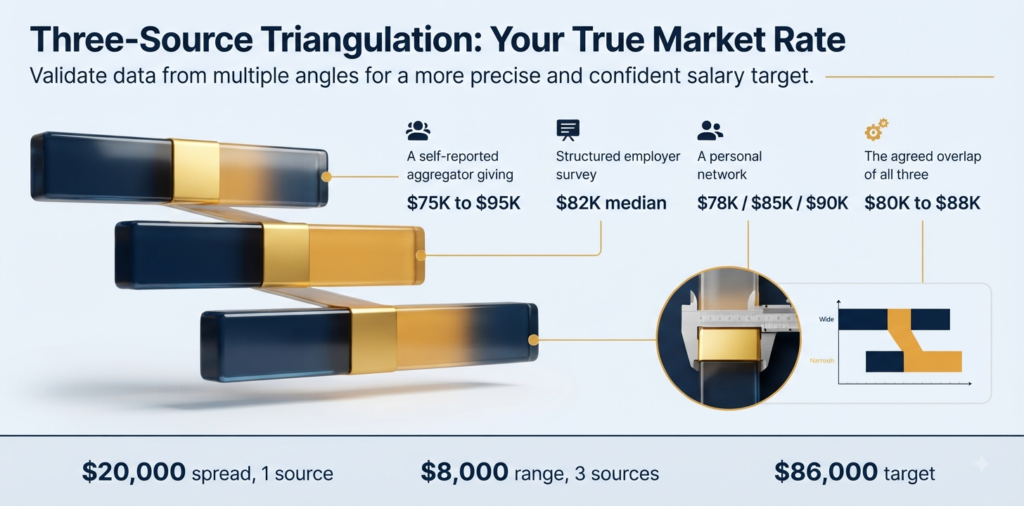
The three-source method behind good salary market research
The method has three categories, and the categories matter more than the specific websites. Sites come and go. The three kinds of evidence stay stable.
Pick one source from each category below. Not three aggregator sites. Salary market research works because the three sources fail in different directions, and three copies of the same source fail together.
Source one, a self-reported salary aggregator
These are sites where employees report their own pay. The numbers come from real people in real roles, which is their strength.
The tradeoff is who bothers to post. Self-reporting skews toward people who feel strongly about their pay, often because their figure sits unusually high or unusually low. For a mid-level product manager role in Austin, Priya finds a self-reported range of $75,000 to $95,000. That $20,000 spread gives her an outer boundary to work inside, and not much else.
Source two, a structured compensation survey
Industry associations and compensation research firms publish role-based salary data. They build it from payroll figures that employers hand over, so it usually runs tighter and steadier than an aggregator.
Government wage data belongs in this category too. The U.S. Bureau of Labor Statistics publishes occupational employment and wage statistics by occupation and metro area, and it collects those figures by surveying employers rather than workers. Priya pulls a median of $82,000 for her role and region from a source in this category.
Source three, people you already know
Three people in comparable roles report $78,000, $85,000, and $90,000. These are real, current numbers from people whose situations Priya can compare against her own.
This source feels the most awkward to gather and often turns out the most useful. It is the only part of salary market research where you can ask follow-up questions. You can find out whether the $90,000 came with a brutal commute or a title bump. No website will tell you that.
| Source | What it captures | Main bias | Priya’s figure |
|---|---|---|---|
| Self-reported aggregator | Real people, real roles, self-posted | Skews toward strong opinions | $75,000 to $95,000 |
| Structured compensation survey | Employer-reported payroll data | Skews toward participating employers | $82,000 median |
| Personal network | Real, current, and askable | Skews toward people you happen to know | $78,000 / $85,000 / $90,000 |
Why three biased sources beat one clean guess
Each source carries a different bias, so lining up three differently biased estimates lets the errors cancel instead of compound.
Aggregators skew toward people motivated enough to post. Structured surveys skew toward whichever employers chose to participate, which is rarely a representative sample. Personal networks skew toward the specific people you happen to know.
None of those biases is fatal alone. None of them points in a predictable direction you could correct for if you only had one source. Yet three different biases, checked against each other, rarely agree on a wrong number by coincidence. So when all three land in the same zone, you can trust that zone more than any single figure inside it.
How the three ranges overlap
Priya’s aggregator range ran from $75,000 to $95,000. On its own, a $20,000 spread is nearly useless in a conversation.
Then she overlays the survey median of $82,000 and her three network figures. The zone where all three sources agree narrows to roughly $80,000 to $88,000. That is an $8,000 spread with three independent sources behind it. Getting from the first spread to the second one is most of the work in salary market research.
The narrower range also sounds better out loud. “Three sources agree on $80,000 to $88,000” is a much harder sentence to argue with than “one website said something between $75,000 and $95,000.”
How to read a posted salary range
More job postings now include a required salary range. That saves you a source, but only if you read the range the way the company meant it.
Why most candidates anchor on the wrong end
The bottom number feels like the safe one to expect, so that is where most candidates quietly park themselves. The assumption is usually wrong.
A posted range typically reflects the full span of experience levels the company would consider. It is not a scale of negotiating room running from stingy to generous. A range of $70,000 to $95,000 usually means the company would pay $70,000 for someone at minimum qualifications and $95,000 for someone at the top of the band.
Companies set those bands with a leveling system that maps to experience and scope. A band is not a discount rack where you politely start at the bottom. A strong candidate has a real argument for the upper half of it.
Priya can cite the range itself as her anchor. “The posted range tops out at $95,000, and my five years of directly relevant experience puts me at that end.” That sentence carries more weight than any figure she could have invented alone. Treat a posted range as salary market research the employer already did, then argue about which end you belong in.
| Assumption | Reality |
|---|---|
| The bottom of the range is the safe number to expect | The bottom usually means minimum qualifications, not typical hires |
| The top of the range is a negotiating fantasy | The top reflects candidates the company already agreed to pay that much |
| A posted range never moves | A range occasionally flexes at the edges for a candidate who exceeds scope |
Check the date before you trust a posted range
A range published eighteen months ago describes a market from eighteen months ago. Pay for in-demand roles can move meaningfully in that window, in either direction.
Treat a stale posting as one useful data point, not as a current one. Weight your other two sources more heavily when the posting is old.
Occasionally a posted range bends at the edges, especially the ceiling, when a candidate brings something the role did not originally account for. That is rarer and needs real justification. Still, it is worth knowing the range is not always a hard wall.
Salary market research for a title nobody else uses
Priya’s real title is “Growth Product Manager.” It is specific enough that none of her three sources have a clean entry for it.
This happens constantly with hybrid roles, newer job titles, and small specialized industries. There is a specific fix for it, so an empty search result is not where the research stops.
Break the role into its component parts
Decompose the title and research the pieces separately. “Growth Product Manager” is functionally a blend of two well-documented roles: Product Manager and Growth or Performance Marketing Manager.
Priya runs the same salary market research on both halves. She finds Product Manager at roughly $80,000 to $88,000 in her market. Growth Marketing Manager lands at roughly $75,000 to $85,000. She places her real role in the overlap, closer to the Product Manager figure, because that is the larger share of her actual responsibilities.
This works because titles are wildly inconsistent across companies, while core responsibilities compare far more cleanly. Two companies might call the identical job “Growth PM” and “Senior Product Manager, Acquisition.” Research what the role does rather than whatever someone in HR decided to call it.
Search live job postings, not just salary sites
Search for the job posting itself instead of a salary aggregator entry. This pairs well with decomposition, and sometimes replaces it outright.
Many listings for hybrid or newly named roles include a required range even when no salary research site has caught up to the title. The company writing that posting knows what budget it holds. Priya finds two live postings for “Growth Product Manager” roles at comparable companies in other cities, both with ranges attached.
A live posting for the exact title you are researching often beats a decomposed estimate. Adjust it for location using the method in the next section.
Adjusting salary market research for city, company size, and industry
National averages describe a market that probably is not yours. Adjust them before you treat any of it as your number.
| Factor | Typical effect | Priya’s example |
|---|---|---|
| City | Scales the number up or down with local cost of living | ~$100,000 (SF-referenced) scales to ~$80,000-$85,000 in Austin |
| Company size | Smaller, earlier-stage companies often pay less cash for more equity | Early-stage cash runs 10 to 15% below an established company |
| Industry | Faster-growing, higher-demand industries pay more for the same title | A fintech PM can outpay an insurance PM at the same seniority |
Your city changes the number most obviously
National data for “Product Manager” often centers on high-cost metro averages. Those do not describe Priya’s Austin market.
The adjustment is simple and defensible. Find a cost-of-living index comparing your city to the reference city behind the national figure, then scale. If a national figure effectively reflects San Francisco pay at roughly $100,000, and Austin runs 15 to 20 percent lower on a standard comparison, that scales to roughly $80,000 to $85,000.
Notice where that lands. It sits inside the same $80,000 to $88,000 range her direct triangulation already produced. Arriving at a similar answer two different ways is a strong signal the number is right. When two methods of salary market research agree, you can stop second-guessing the figure.
Company size shifts cash pay in a predictable direction
A 50-person startup and a 5,000-person established company often pay differently for the same title. The difference usually runs one way.
Smaller, earlier-stage companies frequently pay a somewhat lower cash salary in exchange for equity and faster scope growth. Larger companies pay a higher, steadier cash figure with less upside. A commonly observed pattern puts early-stage cash compensation 10 to 15 percent below a similarly scoped role at an established company in the same market.
Neither structure is objectively better. Yet comparing a startup offer against big-company benchmarks without adjusting will make a fair offer look artificially low. Run it the other way and a big-company offer looks artificially generous.
Industry raises or lowers the same role
A product manager at a fast-growing fintech company and one at a slower-moving insurance company can differ by thousands in the same city, at the same seniority.
The two industries compete for the same talent at very different intensities. When your sources span several industries, weight the ones closest to your target employer more heavily than the broad average.
Turning salary market research into one sentence
All of this work is worthless in the moment if you cannot say it out loud. Salary market research has to compress into something you deliver on a call, confidently, without reading from notes.
Use this format:
“Based on [number] sources for [role] in [location], the market range is [low] to [high], and I’m targeting [your number] given [your one strongest qualification].”
With Priya’s numbers in it:
“Based on three sources for a product manager role in Austin, the market range is $80,000 to $88,000, and I’m targeting $86,000 given my five years of directly relevant experience.”
That is one sentence carrying four separate pieces of evidence, with nothing hedged.
Say it out loud once before you need it in a real conversation. The sentence is short enough to memorize in under a minute. It is specific enough that a recruiter hearing it knows immediately they are talking to someone who did the work.
The same sentence works for a raise
Change one word and the same sentence works in a raise conversation.
“Based on three sources for my current role and level in this market, the range is [low] to [high], and I’m asking for [your number] given [your specific achievement this year].”
“Targeting” becomes “asking for” because the conversation shifted from a new offer to an existing one. Everything else holds, including the research method underneath it. That same evidence carries over when you negotiate a raise during a promotion.
What comes after your salary market research
Salary market research gives you a defensible range, which is not the same thing as an ask.
The next step converts that range into three specific figures: a target, an opening ask, and a walk-away point. Priya’s $80,000 to $88,000 becomes an $86,000 target, a $93,000 opening ask, and a $78,000 walk-away. The free compensation calculator does that conversion from your own numbers, and how much you can negotiate walks through the logic behind each figure.
From there the evidence slots straight into a conversation. It becomes Part 4 of the five-part counteroffer structure in the salary negotiation email guide. It also becomes your fallback when you have no competing offer to lean on, a situation negotiating with multiple offers covers in full.
Salary market research is also the one step you can finish today, alone, without anyone’s permission. Nothing else in the negotiation starts moving until it is done.
Frequently asked questions about salary market research
Salary market research basics
How long does salary market research take?
One focused hour covers the three-source method for a single role. Pull one aggregator range, one structured survey figure, and three real numbers from people you know. A rough version done once beats a polished figure pulled from a single website. Spending more than that first hour rarely adds proportionally more confidence; the value comes from triangulating three different kinds of evidence, not from exhaustive research on any single one. If the role is unusual or the market is thin, a second hour spent on live job postings for comparable titles is a better use of extra time than re-searching the same aggregator sites twice. Treat that first hour as a floor, not a ceiling; revisit it briefly before each new negotiation, since market numbers shift enough year to year that a figure from an old search can quietly go stale.
How many sources do I really need?
Three, from three different categories. Three aggregator sites are still one kind of evidence with one kind of bias. What you want is three biases that cancel each other out, which stacking the same source cannot give you. An aggregator site tells you what companies say they pay in aggregate, a structured survey tells you what people in similar roles actually reported, and a real contact tells you what someone in your specific situation was actually offered. Each source has a different blind spot, so combining three different types catches errors that repeating the same type of source, even three times, would miss entirely. If one of the three categories is thin for your specific role, weight the other two slightly more rather than skipping the check altogether, since even a rough third data point still catches errors a single source alone would miss.
What if my three sources disagree wildly?
Wide disagreement usually means one source describes a different market. Check the city, seniority, and company size behind each figure first. If two sources agree closely and one sits far outside, weight the two that match your situation best. Company size and funding stage also shift the number more than most people expect, since a well-funded startup and a stable enterprise can pay very differently for the same title. If the disagreement still looks wide after checking these factors, treat the outlier as a signal worth a closer look rather than simply discarding it, since it might reflect a real difference in what that specific employer values. When in doubt, favor the source closest to your actual situation over the source with the biggest sample size, since relevance matters more here than raw volume of data.
Should I include equity or bonus in my research?
Research base salary first, since that is what most sources report cleanly. Price the rest of the package separately, then compare full offers on the same scale. Some companies weight equity heavily and offer a lower base in exchange, while others pay closer to market on base and treat equity as a bonus on top. Comparing only base salaries across offers that structure compensation differently can make one offer look worse than it actually is, so build a simple side-by-side once you have real numbers for both pieces. Ask directly during the process which pieces of the package are negotiable and which are fixed, since companies vary widely here and guessing wrong wastes research time on a component that was never actually up for discussion. A five-minute question early saves hours of misdirected research later.
Salary market research in harder situations
How do I research a remote role?
Decide which market the employer prices against, then research that one. Some companies pay a single national rate. Others adjust by your location. Ask directly, because the answer changes which comparison you should be making. If the employer pays a single national rate regardless of where you live, your research should focus on the broader national market for the role rather than your specific city’s cost of living. If they adjust by location, research the specific market you’d actually be working from, even if the job itself is remote, since that’s the number they’ll actually be comparing you against. If the employer stays vague about which market applies, treat that ambiguity itself as worth clarifying in writing before you finalize your number, since the wrong market comparison can throw off your whole range. This one clarifying question prevents most of the bigger research mistakes people make.
What if I have no network in this field?
Lean harder on live job postings with published ranges. Two or three current postings for the same title, at comparable companies, work as a real third source when personal contacts are thin. Reading the full posting carefully also helps, since some list a range that already reflects experience tiers within the role, giving you a rough sense of where a given level of experience should land inside that range rather than just the range as a whole. A short, direct message asking a former colleague what a comparable role paid recently often works better than a vague request for general advice, since specific questions tend to get specific, useful answers instead of a polite non-answer. Most people are more willing to share a real number than you’d expect, if asked directly and privately.
Can I use my current salary as a data point?
Keep it out of the conversation. Your current pay reflects what one employer agreed to at one moment, which tells you very little about the market now. Use it privately to measure the gap, then leave it out of the ask. Your current salary also reflects decisions you made, or leverage you didn’t have, at a different point in your career, none of which the new employer should be weighing when deciding what the role is worth today. Keeping it private protects you from being anchored to an old number instead of the market rate you’ve actually researched. If your current pay was set under very different market conditions, even a year or two ago, treat it as outdated evidence rather than a reliable anchor for what the role is worth today. Markets move faster than most people assume, especially in roles with high demand.
Does salary market research still help if the range is already posted?
Yes. The posted range tells you the company’s band. Your research tells you where inside that band you belong, which is the part you actually have to argue. A posted range without independent research still leaves you guessing whether you’re a strong candidate who should ask for the top of that band or a typical one who should expect the middle, and that distinction is exactly what your own research is meant to answer. A posted range without your own research also leaves you unable to counter convincingly if the employer opens at the bottom of it, since you’d have no independent number to point to as a reason the higher end fits you better. A posted range is a starting point for research, not a substitute for it.
The complete negotiation kit turns this research into the rest of the conversation: the three-number calculator, the word-for-word script, and the counteroffer template. For the moment right after an offer lands, see what to do with a salary offer.
RELATED POSTS
View all


Salary Negotiation Letter Sample: What Should Yours Say?
August 7, 2026 | by The Raise Plan Team

Introduce Yourself in an Interview: What Should You Say?
August 21, 2026 | by The Raise Plan Team