



An elevator pitch interview answer is the short spoken version of your professional story, usually 30 to 60 seconds. You give it when an interviewer says tell me about yourself or walk me through your background. It is the introduction you would use riding an elevator a few floors with a stranger, which is where the name comes from. The structure holds up across settings, so once you have built it you can adapt it for an interview, a career fair, or a hallway conversation.
The pitch is not your resume read out loud. It has three moves in a set order: where you are now, how you got here, and what you want next. Learn it once and you can reuse it in almost any room where you introduce yourself for work.
What is an elevator pitch interview answer?
An elevator pitch interview answer is a brief spoken introduction, around 30 to 60 seconds long. It says who you are professionally and what you are looking for. It opens an interview, and it also stands alone at networking events or on a first call with a recruiter. The pitch gives the listener a clear picture of you before the detailed questions begin.
Treat it as a headline, not the full article. You are not covering every role you have held. You are naming the one thread that ties your background to the room you are in. A recruiter who hears a tight pitch knows what to ask next. One who hears a rambling pitch starts trimming you in their head.
The present past future formula for your elevator pitch
Most strong pitches run in the same order: present, then past, then future. You say what you do now. Then the experience that led here. Then the work you want next and why this role fits. The listener wants your current context first, so the rest of the pitch has somewhere to attach.
| Part | What it covers | Time to spend | Example line |
|---|---|---|---|
| Present | Your current role and main focus | About 15 seconds | I am a marketing analyst at a retail brand, focused on paid search. |
| Past | The experience and one result behind you | About 20 seconds | Before that I ran email campaigns that grew repeat orders by a fifth. |
| Future | The work you want next and why this role fits | About 15 seconds | I want to move into full funnel strategy, which is why this role stood out. |
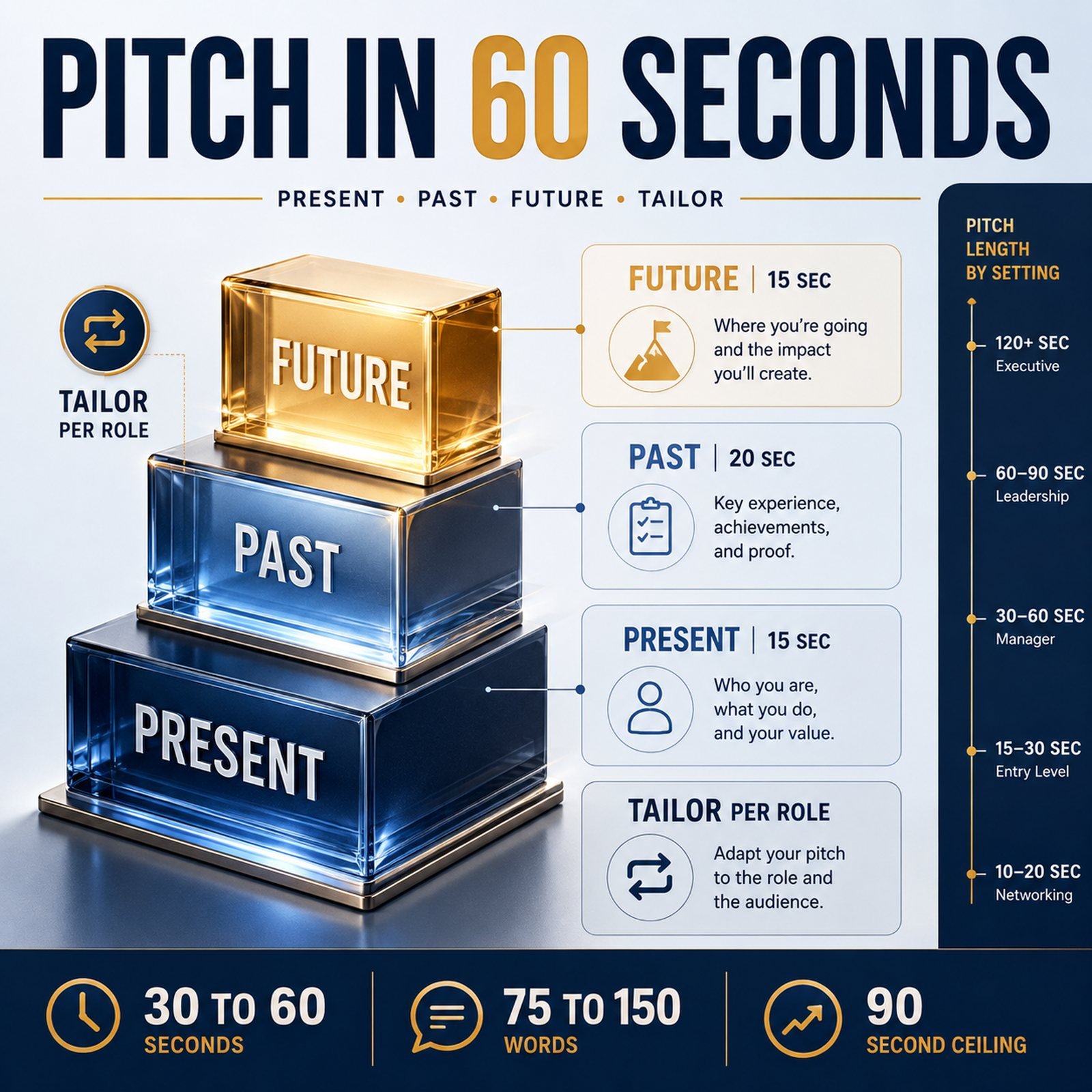
Present is one or two sentences on your current role and main focus. Past is the short version of your track record, with one concrete result if you have one. Future is the bridge line: the kind of work you want and why this company is the place for it. Keep future the shortest of the three. That line is your hook, so hold it to one sentence.
How long should an elevator pitch interview answer be?
Aim for 30 to 60 seconds, which is roughly 75 to 150 spoken words. In a formal interview you can go to 90 seconds if the interviewer asked for a full background walk. At a career fair or in a hallway, stay near 30 seconds, because the other person is standing and scanning the room.
Time yourself out loud, not in your head. Silent reading runs about twice as fast as speaking. A pitch that reads as 40 seconds on the page often runs over a minute out loud. The pauses add up. If you run long, cut the past section first. That is the part people fill with job history nobody asked for.
| Situation | Target length | Why |
|---|---|---|
| Interview opener | 45 to 60 seconds | The interviewer expects a full answer and is taking notes |
| Formal background walk | Up to 90 seconds | They asked you to go long, so give structure, not filler |
| Career fair or expo booth | About 30 seconds | The recruiter is standing and speaking with many people |
| Networking event | 20 to 30 seconds | It is a conversation, so leave room for a reply |
| Video call introduction | 40 to 50 seconds | Attention on screen drops faster, so trim a little |
How to tailor your elevator pitch interview answer to the role
Keep one core pitch, then swap two or three details for each job. Change the result you highlight so it matches what the posting asks for. Change the future line so it names the specific team or problem. The present line usually stays the same.
Read the job description and find the one requirement that repeats or sits at the top. Make your past section speak to it directly. If the role leans on stakeholder work, your one result should involve people, not only numbers. Tailoring means pointing the same pitch at a different target. You adjust a few lines and leave the rest alone.
Elevator pitch interview examples for five situations
Here are five elevator pitch interview examples, each about 45 seconds at speaking pace. Read them out loud to feel the rhythm. Then rebuild each one with your own present, past, and future.
Employed professional exploring a move
I lead the onboarding team at a business software company, where I own the first thirty days of the customer experience. Before this I spent four years in support and built the help center that cut ticket volume for new accounts by a third. I want to move into a role that shapes product decisions with that frontline signal, which is what drew me to this opening on your lifecycle team.
Career changer moving into a new field
For the last six years I taught high school science, where I planned curriculum, managed a department budget, and trained new staff every fall. Two years ago I started building data dashboards for our district on the side, and I finished an analytics certificate this spring. I am moving into data analysis full time now, and your education focused team sits right between where I have been and where I am going.
New graduate with little formal experience
I just finished a degree in mechanical engineering, and my final year project was a low cost water filter that our team took to a regional competition. During school I interned two summers at a manufacturing firm, running quality checks on the assembly line. I am looking for a first role in product engineering where I can learn from a senior team, and your rotational program is built for that.
Networking event or career fair introduction
I am a UX researcher, currently freelance, mostly with early stage health apps. I came from a psychology background and moved into research after a few years running user studies at a hospital. This year I want to join one company full time, ideally somewhere that treats research as part of design rather than a box to check. What does your team work on?
Cold introduction on a call or message
Short version: I am a finance manager at a logistics company, where I run the monthly close for a business unit worth a hundred million dollars. My first five years were in public accounting, so I know the audit side well. I am starting to look for a controller role at a smaller company where I can build the process rather than inherit it. I saw your posting and wanted to reach out directly.
Where you use an elevator pitch outside the interview room
Your elevator pitch interview answer travels well. The same three parts work anywhere someone asks what you do for a living. Career fairs, alumni events, conference hallways, a first call with a recruiter. The first line of a cold message. A family gathering where someone might know of an opening. Build it once and it earns its keep in all of them.
The setting changes two things: length and ending. In an interview you stop and wait for the next question. At a networking event you end with a question back, so it turns into a conversation. In a message you cut it to two lines and add why you are reaching out. The three core parts stay the same. A Harvard Business Review piece on the elevator pitch makes the same case: a short, specific pitch you reuse beats a long one you deliver once.
Mistakes that weaken an elevator pitch interview answer
- Starting too far back. Nobody needs your school major ten years into a career. Start with now.
- Listing every job. The pitch is a headline. A full history belongs in your full tell me about yourself answer.
- No future line. If you never say what you want, the listener guesses, and the guess is usually wrong.
- Speaking in titles only. I was a coordinator, then a specialist, then a lead tells them nothing about the work.
- Reciting a memorized script. A pitch you have learned word for word sounds like one. Learn the beats instead.
- Running long. Past 90 seconds in an interview, or past 30 at a booth, and the room is gone.
- One pitch for every job. Swap the result and the future line each time, or it sounds generic.
How to practice your elevator pitch interview answer out loud
Write the three parts as bullet points, not full sentences. Say it from the bullets, out loud, and time it. Record one take on your phone and listen back for pace, filler words, and whether the future line is clear. Do this five or six times across a few days rather than twenty times in one sitting.
Practice with a person if you can. Ask them to tell you back what they heard you want. If their answer does not match your future line, the pitch is not landing yet. A strong elevator pitch interview answer sounds prepared, not memorized. For the questions that usually follow the pitch, work through our free interview questions practice tool before the real thing.
How your elevator pitch connects to salary questions
A tight elevator pitch interview answer sets up the money conversation later in the process. Once you have stated your level, your track record, and your value, the salary expectations question gets easier. You can answer it with a real number instead of a dodge. Your pitch makes the case early, and the negotiation is where it pays off.
Interviewers often move from your background straight to the salary expectations question in the same call. If your pitch already made your seniority and results concrete, your range sounds supported rather than hopeful. For the structure of that later conversation, see our complete salary negotiation guide. If you want the scripts, question bank, and calculator in one place, the full interview and negotiation kit covers it.
How an elevator pitch differs from a three part interview introduction
They overlap, and inside an interview the elevator pitch is often how you answer tell me about yourself. The difference is scope and setting. A full interview introduction can run 90 seconds to two minutes and lives only in the interview. The elevator pitch is tighter, and it is built to travel to career fairs, recruiter calls, and cold messages.
Think of your elevator pitch interview answer as the portable core. The full interview version is the same thing with room for one short story. For a step by step build with sample scripts, our guide to introducing yourself in an interview walks through each part.
Elevator pitch interview answer: key things to remember
- Use present, past, future, in that order.
- Keep it 30 to 60 seconds, about 75 to 150 spoken words.
- Lead with what you do now, not where you started.
- Put one concrete result in the past section.
- End with a future line that names this role or team.
- Time it out loud, and cut the past section if you run long.
- Keep one core pitch and swap two or three details per job.
Frequently asked questions
What is an elevator pitch interview answer?
An elevator pitch interview answer is a 30 to 60 second spoken introduction that sums up your professional story and what you want next. It runs about 75 to 150 words at speaking pace. Interviewers hear it when they open with tell me about yourself or walk me through your background. You can use the same pitch at career fairs, networking events, and on recruiter calls. The structure is present, past, future: what you do now, the experience and one result that got you here, and the kind of work you want next. Keep the future line short and specific to the role in front of you. It is not your resume read aloud. It is the one thread that connects your background to this room. Learn the three beats rather than a word for word script, and time it out loud, because spoken delivery runs slower than silent reading.
How do you start an elevator pitch in an interview?
Start with your current role and main focus in one plain sentence. For example: I am a project manager at a healthcare company, and I run the rollout of our scheduling product. Avoid opening with your birthplace, your degree, or a slow warm up. The first line should tell the interviewer your level and your field within about ten seconds, so the rest of the pitch has context to attach to. Then move into the past section without a pause, so the pitch feels like one thought rather than three stacked blocks. If you are between jobs, lead with your function and recent focus rather than your last title. Saying I am a data analyst, most recently focused on retention modeling, works better than a dated account of when you left. In an elevator pitch interview answer, that opening line does most of the work, so keep it short and confident.
How is an elevator pitch different from tell me about yourself?
They overlap heavily, and in an interview your elevator pitch is usually how you answer tell me about yourself. The real difference is scope and where you use it. Tell me about yourself can run 90 seconds to two minutes and stays inside the interview, with room for a short story or a specific project. An elevator pitch is tighter, around 30 to 60 seconds. It works at a career fair, on a first recruiter call, or as the opening lines of a message. Build the elevator pitch as your portable core, then expand it for the interview when you have more time. Both use the same present, past, future order, so you are not learning two separate things. You are learning one and adjusting the length. In practice, write the elevator pitch first and get it tight, then let it stretch when the interviewer clearly wants more detail.
What should you not say in an interview elevator pitch?
Skip personal details that do not bear on the work, such as your age, family status, or reasons for leaving that sound like complaints. Do not criticize a current or former employer, even lightly. Leave out salary numbers, because that conversation comes later in the process. Avoid filler such as I am a hard worker and a people person, since it takes time and proves nothing. Do not list every job you have held or recite dates like a timeline. And do not apologize for gaps or a nontraditional path inside the pitch itself. If a gap needs explaining, a short confident line later in the interview does the job better than a defensive note in your opening. Keep the pitch to your current focus, one real result, and where you want to go next.
RELATED POSTS
View all