



You gave notice at your old job, and now the new company says the job is gone. A rescinded job offer is one of the worst turns a search can take, and it happens more often than people admit. Sometimes a background check comes back wrong. Sometimes a budget gets cut a week before the start date. This guide covers why companies pull offers, what to do in the first days, whether you have a legal claim, and how to protect yourself on the next one.
What a rescinded job offer means
A rescinded job offer is an offer the employer withdraws before you start, or sometimes just after. You never became an employee. So this is not a firing, and it is not a layoff. A rescinded job offer is also different from a delayed start, where the offer still stands and only the date moves. Both a verbal offer and a signed offer letter can be pulled. In most of the United States the offer carries no promise of a job. That is why a company can take it back.
Can an employer rescind a job offer?
In almost every case, yes. Most jobs in the United States are at will, so the offer gives you no guaranteed term of employment. The company can withdraw it any time before your first day, and usually after, for almost any reason or for no stated reason at all.
There is one line an employer cannot cross. A company cannot pull an offer because of your race, color, national origin, religion, sex, pregnancy, age, disability, or genetic information. If the timing lines up with the employer learning one of those facts, that is a discrimination question. It belongs with a lawyer rather than a career blog. None of that makes a rescinded job offer feel less personal. It just explains why the law rarely stops one.
Common reasons for a rescinded job offer
Most rescinded offers trace back to one of a few causes. Some are about you, some are about the company, and a few are fixable. The table maps the usual reasons to what each one signals and what you can do about it.
| Reason the offer gets pulled | What it signals | What you can do |
|---|---|---|
| Flagged background check | A record, or a database error such as a mixed file | Ask the screening company for a copy, dispute wrong entries in writing |
| Negative credit check on a finance or government role | Debt, a bankruptcy, or late payments the role screens for | Use your FCRA rights: get the report, explain or dispute before the decision is final |
| A reference came back weak | A former manager was lukewarm or negative | Offer alternate references and give context on the relationship |
| Failed drug test | A policy violation, or a legal prescription you did not disclose | Provide the prescription, ask about a retest |
| Hiring freeze or budget cut | Nothing about you, the role itself was pulled | Ask to be first in line when it reopens, ask for a deferred start |
| A resume detail did not check out | Dates, a title, or a degree did not match records | Correct an honest error fast, accept that a real gap has little recourse |
| Something you posted publicly | A conduct or judgment concern | Limited recourse, this one is usually final |
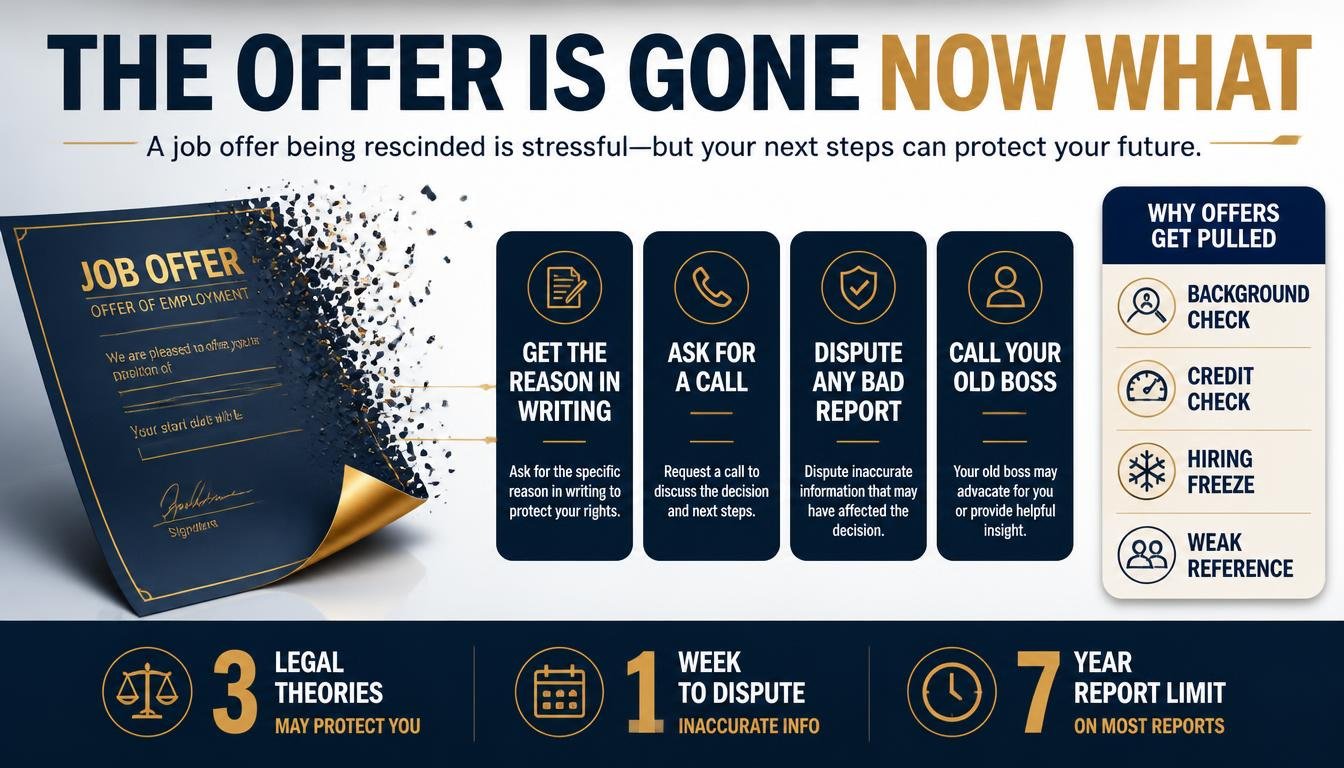
A job offer rescinded after a credit or background check
This is the most common version of a rescinded job offer, and it is also the one where you have the most room to act. Federal law, the Fair Credit Reporting Act, governs how employers use screening reports. The employer needs your written consent to run one. If the report is going to cost you the job, the employer must first send a pre adverse action notice. That notice includes a copy of the report and a summary of your rights. Then the employer has to wait a short period, often about a week, before making the decision final.
Use that week. Read the report line by line. Look for accounts that are not yours, a mixed file with someone of the same name, or old items past the seven year window. Dispute errors in writing with the screening company, not only with the employer, and tell the recruiter you are doing it. When the item is wrong and you correct it fast, some employers will hold the seat open.
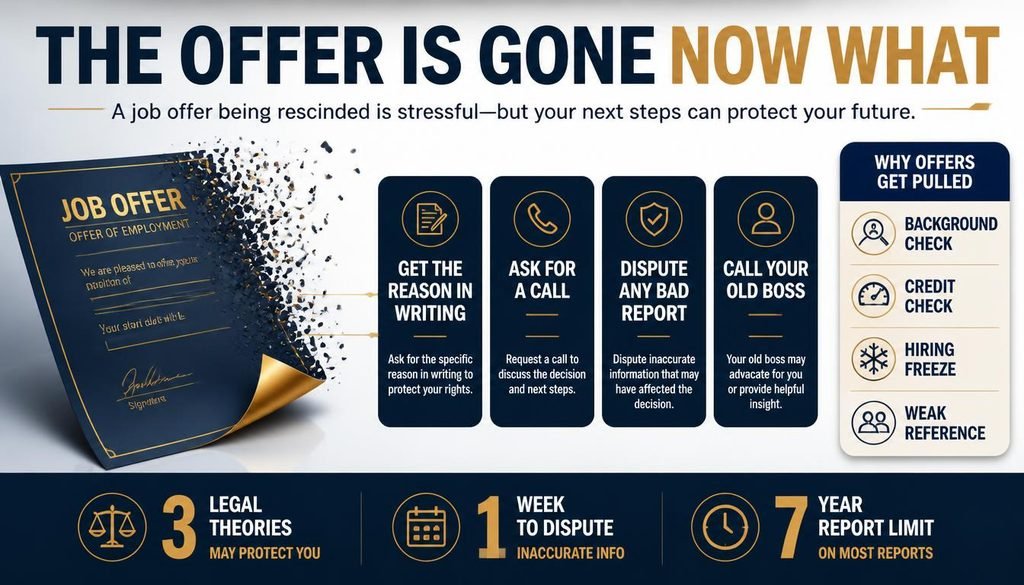
What to do in the first days after a rescinded job offer
Move fast and stay calm. Almost everyone handles a rescinded job offer badly in the first hour. What matters is the first week. It decides both whether you can save the offer and whether you keep the relationship for later.
- Ask for the reason in writing. A short, level email. You want the specific cause, not a vague line about business needs.
- Ask for a call with the recruiter or hiring manager. You are gathering facts, not arguing the decision.
- If the cause is a fixable error, say so plainly. Ask whether a corrected report or a later start date changes the outcome.
- Do not post about it or name the company publicly while anything is still open.
- Restart the search the same week. Treat the lost offer as a gap to close, not a verdict on you.
Then add up what the reversal cost you. Lost paychecks from the job you left, relocation you already paid, a lease you broke, benefits you gave up. Write the number down. You need it for two things: a possible legal claim, and the target on your next offer. A free salary negotiation calculator turns that figure into a defensible ask once the next offer lands. For the wider picture of that stretch, see the hours right after an offer lands.
Can you get your old job back?
It is a long shot, and it is still worth the call. After a rescinded job offer, contact your old manager the same day, before someone fills the role and before word spreads. Be direct. The new offer fell through, and you would like to stay. If they say yes, get the reversal of your resignation in writing. If they say no, you still asked early. That timing matters if you later claim lost wages.
If they come back with more money or a new title to keep you, that is a separate decision. Weigh it the way you would whether to take your old employer’s counteroffer in any other week, not just because you are cornered.
Do you have a legal claim for a rescinded job offer?
Usually the answer is limited, and sometimes it is not. Three theories come up. Talk to an employment lawyer before you rely on any of them. What follows is general information, not legal advice.
| Legal theory | When it may apply | What you could recover |
|---|---|---|
| Promissory estoppel | You reasonably relied on the offer and took a costly step, such as resigning or relocating | Reliance costs only. Relocation, a broken lease, and in some states the wages you would have earned by staying in your old job. Not the salary of the job you never started. Many at will states bar this claim entirely. |
| Breach of contract | You signed a real employment contract with a set term, not an at will offer letter | Whatever the contract provides. Rare outside executive and union roles. |
| Discrimination | The timing lines up with the employer learning your age, disability, pregnancy, religion, or another protected fact | Back pay, and in some cases more. This is an EEOC or state agency claim with strict filing deadlines. |
The practical read is simple. If you moved or quit for this job, a consult is worth it. Many employment lawyers give the first one free. Bring the offer letter, every email, and your list of costs. If you did not take a costly step, a rescinded job offer rarely gives you a case worth filing, and your energy is better spent on the next offer.
Can an employer rescind a job offer you already accepted?
Yes. Accepting the offer, and even signing the letter, does not turn it into a contract in an at will state. A rescinded job offer after acceptance is still a rescinded offer, not a broken contract. What signing can do is set a start date and, in some letters, a clause about notice. Read the letter for that. The remedies above still work the same way. Acceptance mainly changes how the timing looks if you bring a promissory estoppel or discrimination claim. It strengthens the case that you relied on the promise.
How to keep it from happening again
A rescinded job offer usually comes from a gap you could not see at the time. You cannot remove every risk, but you can close the common ones.
- Do not resign until the background check has cleared and you hold a written start date. Ask the recruiter straight out whether the offer is contingent on anything still pending.
- Get the full offer in writing, with salary, title, start date, and every contingency listed.
- Give notice with a buffer. Two weeks is standard, and if you can push your start a few days past the check clearing, do it.
- Keep your exit clean at your old company. If you have to ask for your job back, a good departure is what makes that possible.
When the replacement offer arrives, negotiate it in full. A rescinded job offer is a setback, not a reason to grab the first number someone says. Our guide to how to negotiate salary walks through the whole ask, and if you are weighing whether to push at all, decide whether to push on the next one first. You can also counter the next offer up once it is on the table.
For the underlying rules, the FTC’s guidance on using consumer reports in hiring spells out the notices an employer owes you when a screening report drives the decision, and your right to dispute a wrong report.
Frequently asked questions
What should you do if your job offer is rescinded?
Ask for the reason in writing first, in a short and calm email, so you know the specific cause. Request a call with the recruiter or hiring manager to gather facts, not to argue. If the cause is a fixable error, such as a wrong background report, say so and ask whether a corrected report or a later start date changes the decision. Do not name the company publicly while anything is still open. Call your old employer the same day to ask about staying, before someone fills the role. Add up your costs from the reversal, including lost pay, relocation, and a broken lease, because you need that figure for a possible legal claim and for your next offer. Then restart the search that week and treat the loss as a gap to close.
Can an employer legally rescind a job offer?
In most cases, yes. Nearly all jobs in the United States are at will, so an offer carries no guaranteed term of employment, and a company can withdraw it before or shortly after your start date for almost any reason. The exception is a rescission based on a protected class. An employer cannot pull an offer because of your race, color, national origin, religion, sex, pregnancy, age, disability, or genetic information. If the withdrawal follows right after the employer learns one of those facts, that may be unlawful discrimination, and you should speak with an employment lawyer or file with the EEOC or your state agency. A withdrawal that breaks a signed employment contract with a set term can also give you a claim, though that is rare outside executive and union roles. Accepting the offer or signing an at will offer letter does not change this analysis.
Can a job offer be rescinded after a background check?
Yes, and it is the most common trigger. If a criminal record, a credit problem on a role that screens for it, a failed drug test, or a weak reference shows up, the employer can withdraw the offer. When a screening report drives the decision, the Fair Credit Reporting Act gives you rights. The employer must send a pre adverse action notice with a copy of the report and a summary of your rights, then wait a short period before the decision is final. Use that window to read the report closely, look for records that are not yours or items past the seven year limit, and dispute errors in writing with the screening company. Tell the recruiter you are disputing it. A fast correction of a genuine error sometimes saves the offer. If the company pulled the role for a hiring freeze rather than acting on your report, ask to go first in line when it reopens.
Can you sue for a rescinded job offer?
Sometimes, but the recovery is usually narrow. The main theory is promissory estoppel, which can apply if you reasonably relied on the offer and took a costly step such as quitting your job or moving. Damages cover your reliance costs, like relocation and a broken lease, and in some states the wages you would have earned by staying put, but not the salary of the job you never began. Many at will states bar the claim outright. A signed employment contract with a term can support a breach of contract claim, and a withdrawal tied to a protected class can support a discrimination claim with back pay. If you moved or resigned for the job, talk to an employment lawyer, since many offer a free first consult. If you took no costly step, a lawsuit rarely goes anywhere.
RELATED POSTS
View all