


Salary Expectations Interview Question: How Do You Answer It?
August 19, 2026 | by The Raise Plan Team

That question arrives before an offer sits in front of you. You are still in the information-gathering phase of the negotiation at this point. The salary expectations question is not a trap. It is a decision point. The research you did in Chapter 6 of the complete negotiation kit becomes the answer that shapes the initial offer.
Interviewers ask your salary expectations for one specific reason: to understand whether you are realistic about market rate for the role. They want to know whether negotiating with you would waste time due to an unrealistic anchor. Your answer shows whether you did real research or whether you are guessing. Saying you are flexible signals the second one. It invites them to anchor on the low end of what they are willing to pay, because you just told them any number works for you.
The cost of getting this wrong compounds. If you understate your salary expectations interview question answer by even 5 percent because you said flexible instead of naming a researched range, that difference carries through your entire salary at that company. A 5 percent gap on a $80,000 salary is $4,000 in year one, and if you stay in the role for five years without leaving for a higher-paying competitor, that single answer in an interview has cost you roughly $22,000 when you factor in raises that build on the lower base. That is the cost of one conversation handled wrong.
$4,000 in year one. $22,000 over five years. That is what a “flexible” answer costs on a single $80,000 salary once raises compound on the lower base.
This guide walks through what that question is asking, why answering with a researched range works better than a single number or vague flexibility, and how to deliver your salary expectations interview question answer in a way that sounds confident without sounding entitled.
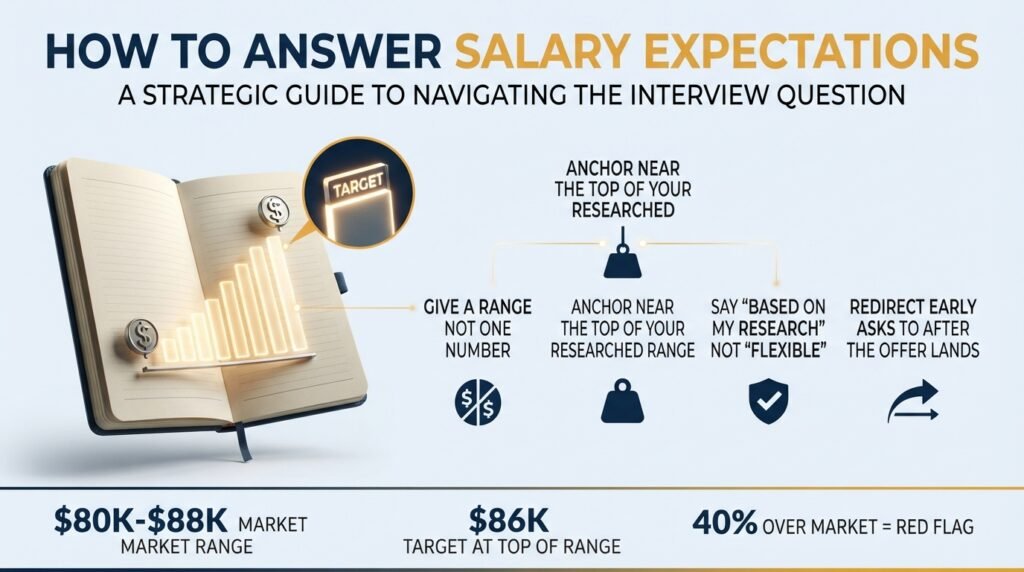
Quick answer: Never say “flexible.” State a researched range with your target inside it: “Based on [X] sources for [role] in [location], the market range is [low] to [high], and I am targeting [number] given [qualification].” One sentence, no apology, no hedging.
What is the salary expectations interview question really asking?
The most misunderstood part of the salary expectations conversation is what the interviewer needs to hear. Candidates often assume the question means “Tell us the absolute lowest number you would ever accept.” It does not.
The salary expectations interview question serves two jobs at once. First, it screens for people anchored to numbers so far outside market reality that an offer cannot close the gap. A candidate expecting 40 percent above market rate for the role either misunderstands the role itself or has unrealistic confidence in their value, both worth identifying before making an offer. Second, it shows whether you have done any homework at all.
An interviewer who hears “I am flexible” learns that you either did not research the market or you did but are unwilling to share what you found. Either way, they learn you are not taking the conversation seriously. An interviewer who hears “Based on my research into comparable roles, the market range is approximately $80,000 to $88,000, and I am targeting $86,000 given my five years of directly relevant experience” learns three things: you did the work, you are thinking about this like a professional, and you are anchored to a defensible number they can work with in good faith.
The best salary expectations interview question answers show research, not neediness. A number backed by multiple sources, stated matter-of-factly, does this. A range offered apologetically or tentatively does the opposite.
| Your answer | What it signals | What happens next |
|---|---|---|
| “I’m flexible” | No research, or unwillingness to share it | They anchor to their own low end |
| A single number | A ceiling with only one direction to move | The offer comes in below it |
| A researched range with a target | Real market work, professional thinking | An offer inside the range feels like a fair compromise |
Why should you never say you’re flexible?
Flexibility sounds considerate. In a negotiation, it is a lack of conviction about what you deserve.
When you offer a range, hiring managers typically anchor on the low end of it as their internal reference point. When you say you are flexible, you essentially remove the low end of your range entirely and invite them to anchor on their own low end instead. That almost always lands lower than where your own research would have suggested.
The salary expectations interview question happens at the moment when you have maximum informational advantage. You have already done your research in Chapter 6, using triangulation across three independent sources. You know the defensible market range. The hiring manager does not know whether you know it. If you say nothing, or hedge with flexibility, you squander that advantage.
There is also a practical issue with flexibility in this stage of the conversation. Once you say you are flexible during the interview, everything that comes after gets anchored to that statement. When the actual offer arrives with a number that is lower than what you researched, you cannot suddenly claim you did real market research and wanted more. You already told them flexibility was your position. Changing that story later reads as dishonest, not like you discovered new information.
The salary expectations interview question is your moment to anchor first. Once you walk into the offer negotiation with your research already on record, the conversation shifts from “What do you want?” to “Let us find a number that works for you, given what you already told us you researched.”
How do you research your salary expectations before the interview?
Chapter 6 of the complete kit walks through the three-source triangulation method in detail. Here is how it applies to the salary expectations interview question specifically.
Use three independent sources to build a defensible range. A self-reported aggregator like Glassdoor or Levels.fyi (Source 1) captures what employees post as real numbers. Industry surveys and benchmarking reports (Source 2) come from associations and firms like the Bureau of Labor Statistics, which builds data from employer-submitted payroll rather than self-reports. Your own network conversations (Source 3) involve three or more people currently in roles similar to yours, in your target city, who can tell you what they earn.
How do you find convergence in your salary expectations research?
When those three sources converge, they converge on a range, not a single number. Priya, the example from Chapter 7, researched a product manager role in Austin. Source 1 showed a wide $75,000 to $95,000 range. Source 2 showed a median of $82,000. Her network reported $78,000, $85,000, and $90,000. Where all three agree is roughly $80,000 to $88,000. That convergence is what makes the range defensible. It is not a guess. It is a data-backed assertion that multiple independent sources agree on that range.
Write down your three sources as you find them. Do not rely on memory during the actual interview. The salary expectations interview question might come up when you are not expecting it, and having your research written down where you can reference it later (or even during the conversation if it happens over email) means you can state your range with confidence, because you know exactly where it came from.
Pay special attention to posted salary ranges in the actual job listing. Many job postings now include a required salary range, and that range usually reflects the company’s own compensation band for the role, not a discount scale. If the posted range is $70,000 to $95,000 and your research puts you in the top half of that band, citing the range itself becomes part of your answer. “The posted range tops out at $95,000, and my five years of directly relevant experience puts me at that end” ties your expectation to something the company already published about themselves.
How do you answer the salary expectations interview question?
There is a formula for this, and it is worth practicing out loud once before you need it in a real conversation.
“Based on [number] sources for [role] in [location], the market range is [low] to [high], and I am targeting [your number] given [your strongest qualification].”
Applied to a real example: “Based on three sources for a product manager role in Austin, the market range is approximately $80,000 to $88,000, and I am targeting $86,000 given my five years of directly relevant experience.”
| Part of the sentence | What it does |
|---|---|
| “Based on [number] sources” | Shows real, verifiable research |
| “for [role] in [location]” | Rules out a generic national average |
| “the market range is [low] to [high]” | Proves you understand the market, not just your own number |
| “I am targeting [your number] given [qualification]” | Anchors your target to something concrete |
What’s the formula for answering the salary expectations interview question?
Every part of that sentence does a specific job. Naming the number of sources shows you did rigorous research. Naming the role and location shows you did not grab a national average. Stating the range shows you understand the market, not just your own number. Ending with a specific qualification that justifies your target in that range anchors to something concrete, not a vague claim of value.
Notice what is absent: no apology, no hedging like “I hope this is reasonable,” no explanation of personal financial needs. None of that adds credibility. It only makes your answer longer and less confident-sounding. The salary expectations interview question gets answered with one clear, data-backed sentence. That is the entire answer you need.
If the interviewer pushes back and asks why you are targeting that specific number in the range, you have one strong answer. One of your three sources placed you there, or the posted job range puts candidates with your experience at that level. You are not inventing the number. You are reading what the data shows.
If they ask whether there is flexibility, do not suddenly become flexible. Say: “I am confident we can find a number that reflects both the market and the value I will bring to this role.” This reinforces your interest while keeping your range intact. You are not negotiating down from research you already presented. You are stating that you trust the conversation to land somewhere reasonable within the defensible range you already explained.
What do you do when the salary expectations interview question comes up on a call?
If the question arrives as a surprise during a live video call or phone interview, use the buy-time script from Chapter 2 to avoid answering under pressure. Try this: “Let me think through that clearly and get back to you in writing, so we are both looking at the same numbers. Is that okay?”
Most interviewers will agree. Once you have time to pull up your research, send an email using the same approach that applies to offer negotiations in Chapter 8: clear, structured, backed by evidence.
Thank you for asking about my salary expectations. Based on three independent sources for a product manager role in Austin, the market range for this position is approximately $80,000 to $88,000, and given my five years of directly relevant experience, I am targeting $86,000. I am excited about this opportunity and confident we can find a number that works for both of us. Looking forward to continuing our conversation.
That email does what the formula does in conversation: it states your research, your target, and your interest, in a way that signals you are serious without being difficult. Once you send it, the salary expectations interview question is answered on the record, in writing, and you cannot be misquoted or second-guessed later.
If they ask you to say it out loud on the call before you hang up, you have two options. Option 1: use the one-sentence formula you have already practiced: “Based on three sources for this role in this location, the market range is approximately $80,000 to $88,000, and I am targeting $86,000 given my experience.” Option 2: tell them you will send it in writing: “I want to make sure I state this clearly. Let me send you an email with my thinking so we have it documented.” Many interviewers will respect written communication on a topic this important, because salary conversations matter enough to get right.
What do you do when the salary expectations question comes up in an application form?
Some companies ask the salary expectations interview question as part of the online application, before anyone talks to you on the phone. This is an advantage: you can be thoughtful and reference your research without inventing the answer on the spot.
Fill in the range using the same formula you would use verbally. If they ask for a single number, give your target number from Chapter 7, not your opening ask. The application form is not a negotiation yet. It is a screening step. Your target number (what you would genuinely be satisfied with) shows you are realistic and researched.
If the form asks “Are you flexible on salary?” do not check “yes.” Flexibility shows you did not do your research. Leave it unchecked. If you must answer, select “No, based on market research for this role” when that option is available. You are not being inflexible. You are being professional.
Some companies make the salary expectations question a required field with no option to skip it. This is when having done your research pays off. You fill it in confidently because you have done the work. A candidate who says $80,000 to $88,000 based on three sources reads very different. A candidate who says $100,000 or $60,000 with no explanation makes a weaker impression. The range based on research lets you pass the screening without anchoring too high. An inflated anchor might get you rejected as unrealistic. A too-low anchor might cost you negotiating room later.
What changes when you get the salary expectations interview question at the interview stage?
If you get through the screening and are invited to interview, treat that salary expectations information as already on record. The interviewer may reference what you wrote: “I see you put $80,000 to $88,000 on your application.” You can confirm: “Yes, based on my research for this role in this market, that is the defensible range. I am targeting $86,000 given my experience.” You have not changed your answer. You are just restating it with more detail now that you are talking to someone face to face.<!– BODY IMAGE PLACEHOLDER: visual comparison or methodology diagram. “Triangulation to defensible range” showing how three sources with different biases converge. Or: “What the interviewer hears” when you say different things (flex vs researched vs single guess). Approx 600×400px, embedded mid-article around here. Navy/gold palette. –>
Why is a range stronger than a single number?
Many candidates think they should anchor to the highest number they can defend, stake it out, and hope to land there. The salary expectations interview question rewards the opposite approach.
When you name a single number, the interviewer’s job is to make an offer below it, because the expectation in any negotiation is that both sides will move at least once. Naming $92,000 sets the conversation up so the only direction it can go is down.
When you name a range with your target in it, the interviewer still expects negotiation. Now that expectation applies within a range you already defined. If you state $80,000 to $88,000 as your market range and $86,000 as your target, an offer at $85,000 or $87,000 feels like a normal compromise. It reads as fair, not like they are undercutting you within the established range.
A range also gives you an informational advantage. With only one number, the interviewer accepts, rejects, or counters below it. A range with a target inside lets them see the whole market, not just what you want. You show you are thinking about the role professionally, not just your own paycheck. An interviewer who understands you are trying to land somewhere that reflects market reality, not just maximize your personal ask, is more likely to work with you to find that number.
How does your salary expectations interview question answer connect to the negotiation that comes later?
Answering the salary expectations interview question with research is not the end of the negotiation. It is the beginning.
Once you have stated your research and your target, an actual offer arrives. At that point, everything in the earlier chapters of the complete negotiation kit applies. The 3-number framework from Chapter 7 still governs your walk-away point and your opening ask if you need to counter. The email structure from Chapter 8 still applies if the negotiation happens in writing. Your research is now on the record from the interview. The hiring manager cannot claim they did not know what you were targeting.
That earlier answer becomes a reference point in the later negotiation. When you send a counteroffer email, you can reference your earlier research without restating the whole case: “As I mentioned during our interview, my research put the market range at $80,000 to $88,000. I would like to discuss a base salary of $86,000, which falls at the top of that range given my experience.”
The salary expectations interview question also shows what this company pays in practice. If they ask your research-backed target and then offer significantly below it, that information tells you whether they negotiate fairly or whether they anchor to the lowest possible number regardless of market reality. You need that answer before you decide whether to pursue the offer further.
How do you prepare your answer to the salary expectations interview question?
Do this before your next interview:
Pick the role you are most likely to interview for in the next few months. Run the three-source triangulation from Chapter 6 using your actual job title and target city. Do not use a generic search. Write down each source as you find it, along with what it showed. Write down the three numbers where all sources converge.
Pick your target number within that range, using the same logic Chapter 6 explains: the point where your experience level and specific qualifications justify your place in that range. Do not round it to something comfortable-sounding. If your research says $86,000, write $86,000, not $85,000.
Practice saying your one-sentence answer out loud once, using the formula above. It takes about 30 seconds to memorize and two minutes to practice. That rehearsal is what makes the difference between sounding confident and sounding scripted when the actual question arrives.
Save the formula to your phone or a note you can reference. If the salary expectations interview question catches you by surprise and you need to send an answer in writing later, you can look back at your research and construct your response without panic.
Recap: Never say “flexible.” Use three sources to build a defensible range. State the range with your target inside it, not a single number. Practice the one-sentence formula out loud once. If asked live and unprepared, buy time and follow up in writing.
Frequently asked questions about the salary expectations interview question
Answering without competing offers or benefit details
What if I do not have a competing offer yet when they ask?
Your answer does not change. The salary expectations interview question gets answered with market research, not leverage. A competing offer is useful later if the negotiation stalls, but your market research is your answer now. “Based on three sources, the range is $80,000 to $88,000, and I am targeting $86,000” needs no competing offer to be credible. The research itself is the evidence. You are not claiming you have another offer on the table. You are claiming you know what the market pays, backed by the three sources you found. If the interviewer presses further and asks what a competing offer would look like, it’s fine to say you’re still early in your search and don’t have one yet; the market research stands on its own regardless of where else you’re interviewing. That answer holds up because it’s true, not because it’s clever.
Should I include benefits or just base salary in my salary expectations interview question answer?
Keep it to base salary in the interview. When the offer arrives, Chapter 5 teaches you to convert the entire package (base, bonus, retirement match, PTO, benefits) into one comparable total value. During the interview, however, benefits have not been specified yet. Stick to what you can reliably compare across sources: base salary. Once you have a real offer with specific benefits, the calculator method from Chapter 7 applies to the whole package. A range built on base salary alone is defensible because you are comparing apples to apples. Trying to include benefit estimates in your salary expectations interview question answer only weakens your position by introducing variables the interviewer can challenge. If an interviewer asks you to estimate total compensation anyway, it’s reasonable to say you’d need the specific benefits details first before giving an honest number. That request itself is a normal, professional boundary to hold.
Handling budget pushback and range disagreements
What if they ask for a range, and I give one, but it is too high for their budget?
That is information. If you state your market research as $80,000 to $88,000 and they say that is above their budget, you have learned the company pays below market for the role. This answer matters before you decide whether to pursue the offer. Do not lower your research-backed range to fit their budget. Acknowledge their constraint and decide whether the non-monetary benefits of the role justify accepting below-market pay. Try this: “I appreciate you sharing that. My research shows the market for this role in this location is $80,000 to $88,000, but I understand budget constraints are real. I am still very interested in the role. Let us see what is possible.” You show that you know what the market says, you respect their constraints, and you remain interested. That tone moves conversations forward even when there is a gap.
Can I adjust my salary expectations interview question answer based on how excited I am about the role?
No. Your research does not change based on your feelings about the opportunity. The market range is the market range, and your target is built from that, not from how much you want the job. If you want the job badly enough that you are willing to accept below your target, that is a decision you make later, once an actual offer arrives and you can weigh all the factors. During the interview, stick to your research. Enthusiasm comes across in other ways: how you talk about the company, the problems you want to solve, the people you want to work with. The salary expectations interview question is not where you prove your enthusiasm. It is where you prove you are grounded in reality. Save any genuine excitement for the parts of the conversation where it actually belongs: the role itself, the team, the problems worth solving, not the number.
What if the interviewer shares their budget ceiling with me during the interview?
Listen carefully. If they volunteer “Our budget tops out at $90,000,” that is information that helps you decide how interested you are. Do not immediately counter with a higher number just because they shared a threshold. They told you something for a reason: they want to know if you can work within it. Try this: “That is helpful context. Based on my research, I was targeting $86,000, so that works well for me, and I appreciate you being upfront about the constraints.” You show that your research-backed target fits inside their budget, you respect the constraint, and you remain genuinely interested. Your salary expectations interview question answer already established your research. Knowing their ceiling just narrows the range where a deal can close, and you already knew that range going in. That single sentence does most of the real work in this exchange, since it shows preparation without sounding rehearsed.
What if they push back and say my range is too high for the role I am applying for?
Push back gently. The salary expectations interview question answer you gave was based on the role as described and your experience level in that market. If they are suggesting the range is wrong, clarify: “I based that on the job description you sent and comparable product manager roles in [city]. Can you help me understand what is different about this role that would move it below market?” This requires them to explain why they think the market range should not apply. Sometimes they have a real reason (the role is more junior than you thought, or they are in a lower-cost market than you researched). Sometimes they are just trying to negotiate down from your opening anchor. Either way, you get information. Either answer gives you something useful to carry into the rest of the process, whether it changes your approach or simply confirms your research was right.
Salary history and adjusting your answer
Should I mention my current salary or salary history when answering the salary expectations interview question?
No, and many states now prohibit interviewers from asking for it. Your market research stands on its own. Mentioning what you currently earn, especially if it is lower than your research shows the new role pays, only weakens your position. An interviewer who hears you currently earn $75,000 will anchor to that number regardless of what the market says. Your salary expectations interview question answer should be rooted in the market for the new role, not in what you happened to be paid in a previous, potentially very different role. If the interviewer asks directly, say this: “I prefer to focus on the value I will bring to this role and what the market pays for it. Based on my research, the range is approximately $80,000 to $88,000. That distinction alone protects your number from being anchored to a role, or a pay history, that has nothing to do with the one actually being discussed.”
For the full toolkit to navigate every stage of the negotiation, from interview through offer, the complete negotiation kit includes the research-backed 3-number calculator (build your target, opening ask, and walk-away from your own market research), the interview preparation quiz (practice other interview moments that affect your paycheck, no sign-up wall), and the full How to Negotiate Salary guide for the complete picture. Once the offer arrives, How Much Can You Negotiate Salary? walks through your three working numbers and how much room you have to move. The same research method in this guide applies whether you are answering a question in an interview, crafting a counteroffer via email, or handling an offer you did not expect to negotiate.
RELATED POSTS
View all