



Should I negotiate salary? Yes, in almost every case. What actually matters is how you ask, not whether you ask. Most candidates who counter an offer get at least part of what they requested. Companies build room into their initial number expecting a conversation, not a signature on sight.
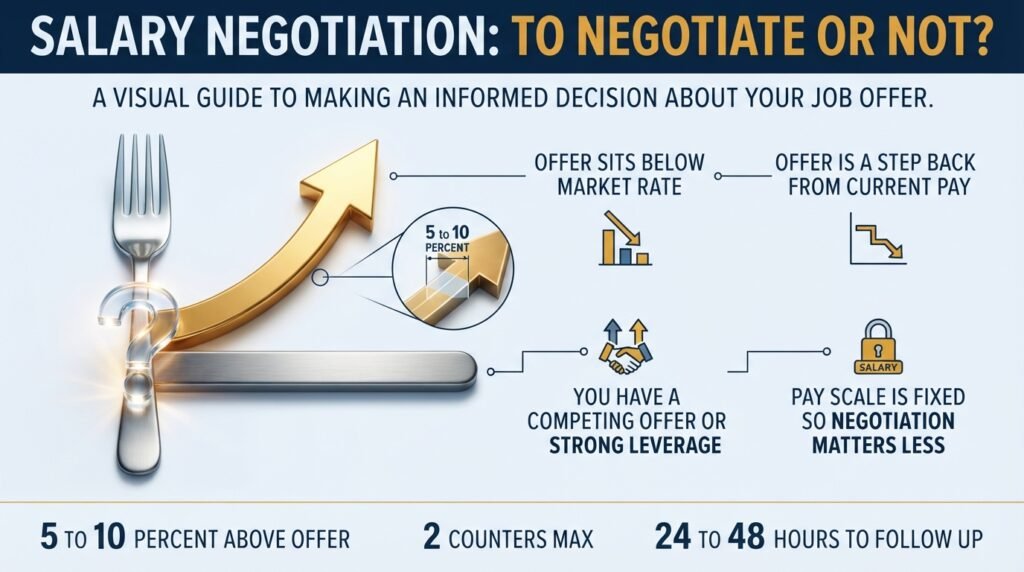
| Negotiate when | Hold back when |
|---|---|
| Offer sits below your researched market range | Pay follows a fixed, published scale |
| Offer is a step back from current pay | Offer already sits at or above your researched range |
| You have a competing offer or strong leverage | You have not received a written offer yet |
When should I negotiate salary?
Negotiate when the number in front of you does not match what the role, your experience, or the market supports. Three situations make the case clearest.
The offer sits below what similar roles pay in your market. You will not know this for certain without checking. That is why triangulating three independent sources for salary market research comes before any conversation with the employer, not after. Once you have a target number, the free salary negotiation calculator turns it into a concrete ask, walk-away point, and opening number in a few minutes. A number without research behind it is a guess, and guesses are easy for a recruiter to dismiss.
The offer would require you to take a step back from your current pay or your last role’s trajectory. Employers rarely volunteer a match to your current salary unless you name it directly.
You have a competing offer, a strong track record in the exact skills the role needs, or both. Leverage does not require drama. It just requires the employer to understand what they are choosing between. For the full script once you decide to move, see how to negotiate salary in any industry.
When should you not negotiate salary?
Skip the negotiation, or keep it very light, in a few specific situations. The role pays on a fixed, published scale with no room to move, common in government, union, and some large union-adjacent employers. The offer already sits at or above the top of your own researched range. Negotiating for its own sake, at that point, reads as reflexive rather than reasoned. Or you are early in the process and have not received a written offer yet. Bringing up numbers before an employer has committed to you removes your leverage instead of building it.
Outside of those cases, silence is rarely the safer choice. It just feels safer.
Can you lose a job offer for negotiating salary?
It happens, but it is rare. It gets rarer the more professionally the ask is framed. Most hiring teams expect a counter and budget for it before the offer ever reaches you. Indeed’s research on job offer negotiation found that the large majority of candidates who countered on salary, other compensation, or both, got at least some of what they asked for.
The risk goes up in three cases: an ultimatum, an ask repeated more than once or twice, or a number raised before you have shown real enthusiasm for the role. It goes down when you lead with gratitude and back your number with a source the employer can verify.
What happens if the employer says no?
A no on salary is not the end of the conversation, it is a redirect. Ask what flexibility exists elsewhere: a signing bonus, an earlier compensation review, extra vacation days, remote flexibility, or a title that better reflects the role. Employers who cannot move a base salary number for internal equity reasons often can move on everything around it.
If nothing moves and the offer still falls short of what you need, you are allowed to decline. A clear, polite decline that names the gap keeps the relationship intact for a future opening. That happens more often than people expect. Once you decide to move forward, whether on the original number or an improved one, the next 24 to 48 hours matter for how the rest of the process goes. See what to do in the first 24 to 48 hours after a salary negotiation offer for that step.
Does salary negotiation work differently by industry?
The mechanics stay the same everywhere: research your number, state it with one reason, and ask a direct question. What changes by industry is how much room typically exists. Fast-growing tech and sales roles with commission structures tend to have wider bands and faster decision cycles. Public sector, education, and heavily unionized roles tend to have narrower or fixed bands instead. That is the case described above, where negotiation matters less than understanding the scale itself.
If you are still asking yourself whether you should negotiate salary in your specific case, the safest test is the researched band above. When you are not sure which situation you are in, just ask. Ask directly whether the posted or offered number reflects a fixed band or a starting point for discussion. Most recruiters will tell you honestly if asked plainly.
What if the counter offer is benefits instead of more money?
Treat non-salary offers as real value, not a consolation prize, but do the math before accepting them as a substitute. An extra week of vacation, a signing bonus, or accelerated review timing can be worth negotiating for on their own. What it should not do is quietly replace a base salary gap. That gap compounds every year you stay, including into future raises calculated as a percentage of that base. If the number you are asking for is defensible, hold the line on it separately from the benefits conversation, instead of trading one for the other by default.
How do you follow up after negotiating?
Once you have a plan, the actual conversation is where most of the anxiety lives. The Salary Negotiation Kit gives you word-for-word scripts for the exact scenarios above, so you are not improvising the hardest sentence of the conversation in real time. Send a short thank you within a day of the conversation, whether the answer was yes, no, or somewhere in between. Confirm in writing whatever was agreed, even informally, so there is a record before the formal offer letter arrives. If the employer needs time to check with finance or leadership, ask for a specific date to follow up. Do not leave it open ended. A specific date signals that you are organized and still genuinely interested, not that you are applying pressure.
Frequently asked questions
Should I negotiate salary?
Yes. Negotiating a salary offer is a normal, expected part of hiring, not a breach of etiquette. Most employers build negotiation room into their first number specifically because they expect a counter, and recruiters handle these conversations routinely. What usually stops people is not risk, it is discomfort with the conversation itself, and that discomfort fades once you have a script instead of a blank page. A simple, low-risk starting point is to thank the recruiter for the offer, then ask one direct question, such as whether there is flexibility on the base number, before deciding whether to push further. Practicing that one sentence out loud once, even alone, makes it noticeably easier to say for real.
Can negotiating salary backfire?
It can, though it is uncommon. Negotiation tends to backfire in a few situations: an ultimatum, an ask repeated more than once or twice after an initial answer, or a number raised before you have shown genuine interest in the role. It also backfires when the number requested has no research behind it. That makes it easy for a hiring manager to dismiss outright. A specific, sourced number, real enthusiasm for the role, and a direct question instead of a demand keep the conversation collaborative instead of adversarial. That combination is what protects the offer. One added safeguard: ask once, wait for a real answer, and treat a second counter as the exception, not the default, since a back and forth that drags past two rounds starts to read as friction rather than negotiation.
How much should I ask for when I negotiate salary?
The right number comes from your own market research, not a flat percentage rule of thumb. Triangulate salary data from at least three independent sources for your exact role, location, and experience level. Anchor your ask inside that researched range, not an arbitrary figure above the offer. Asking for a number you cannot defend with a source undermines the rest of the conversation. A specific, sourced target within market range gives the employer something concrete to respond to, instead of a guess they have to push back on. As a rough starting point, five to ten percent above the offer is usually defensible without extra justification, though a documented gap from your market research can support asking for more.
Should I negotiate salary over email or by phone?
Either works, and the better choice depends on your own comfort more than any hard rule. Email gives you time to write exactly what you mean without the pressure of an on the spot response. It also creates a written record automatically. A call or video conversation can build warmth faster and lets you read the other side’s reaction in real time. That sometimes surfaces flexibility that would not come through in writing. If you negotiate by phone, always follow up with a short email confirming what you discussed, so nothing agreed to informally gets lost before the final offer letter. If you tend to freeze up or agree too quickly under pressure in live conversations, email removes that risk entirely and is the safer default.
Should I negotiate salary after already accepting the offer?
It is harder, but not automatically closed, especially in the narrow window between accepting verbally and signing final paperwork or starting the role. Reopening the conversation after acceptance works best with new, specific information you did not have before. A competing offer that arrived late, or market data you had not yet gathered, both count. Frame it as new information rather than a change of mind, and expect less flexibility than you had before accepting. Once you have started the role, the better path for a legitimate pay gap is usually the formal review cycle rather than reopening the original offer. Reopening it after day one, without new information, tends to damage trust more than the extra dollars are worth.
RELATED POSTS
View all


How to Negotiate Salary With Multiple Job Offers
August 11, 2026 | by The Raise Plan Team

Salary Expectations Interview Question: How Do You Answer It?
August 19, 2026 | by The Raise Plan Team