



You handed in your notice and your manager did not accept it. Instead you got more money, a new title, or a promise that things will change. Knowing how to handle a counteroffer is what stands between a clear decision and a choice you make under pressure in a hallway. This guide is how to handle a counteroffer from your current employer, start to finish. It covers what one usually means, how to evaluate it in a day, the words to accept or decline it, and why most people who stay end up leaving within a year anyway.
Should you accept a counteroffer, or stick with your resignation?
Answer one question first. Was money the only reason you were leaving? If pay was the whole problem and the rest of the job was good, a counteroffer can be a real fix. You should have asked for that raise before you ever started interviewing, but the option is still on the table now. If you were leaving over the manager, the workload, or a ceiling on your growth, money does not touch the reason you left. A raise that lands on the same broken situation buys a few calm months and nothing more. That is the core of how to handle a counteroffer: match the offer against the real reason, not the salary line.
Before you were sure you wanted out, the honest move was to ask for that raise in your current job. It is too late to rewind that. It does tell you something, though. If a resignation letter is what it took to get the number, the number was always there and they were fine not paying it.
How to handle a counteroffer in five steps
Most of how to handle a counteroffer is timing: slow on the outside, fast on the inside. Do not react in the room. Ask for the offer in writing, give yourself a short deadline, and check it against the reason you resigned. The table below shows what each step looks like and the trap that sits next to it.
| Step | What to do | What to avoid |
|---|---|---|
| Do not answer on the spot | Say you are flattered and need a day to think it through | Saying yes in the meeting because the room feels warm |
| Get it in writing | Ask for the new salary, title, and any promises by email | Accepting a verbal number with a vague “we will sort it out” |
| Set your own deadline | Give yourself 24 to 48 hours, and tell the other company when to expect your call | Letting both sides wait while you stall |
| Test it against your real reason | Write down why you resigned, then check if the offer changes that line | Letting the raise alone decide it |
| Decide, then close both loops the same day | Tell your employer, then call the other company right after | Accepting the counteroffer and going quiet on the new employer |
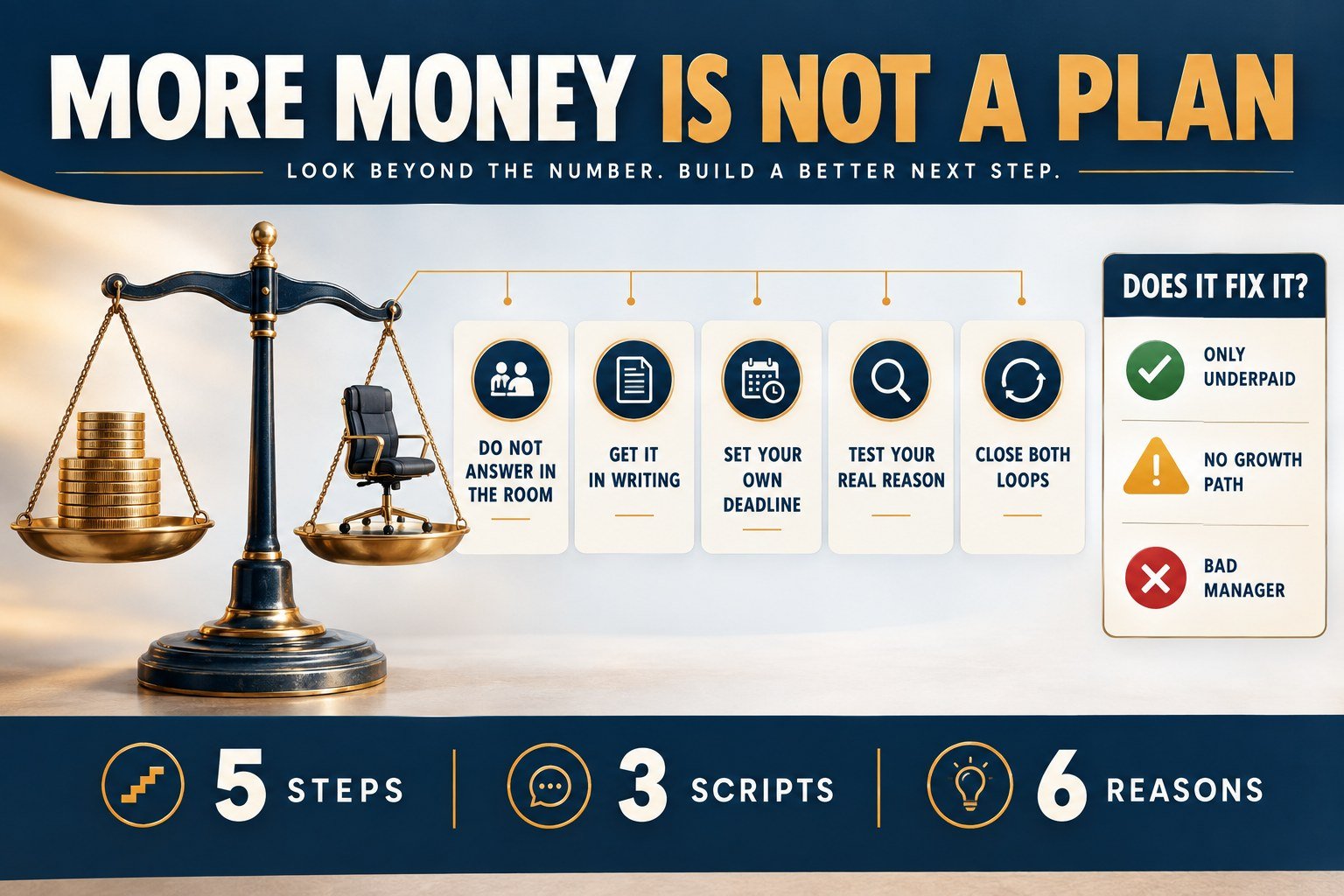
Steps one through three buy you room. Step four is the one that decides it. The next section covers what a retention counteroffer is really telling you.
What a retention counteroffer really means
A counteroffer is a reaction, not a plan. Your employer built a budget for the year, set your raise inside it, and moved on. The counteroffer is that plan breaking under a deadline. It often means your manager does not want the cost of a search, the awkward talk with their own boss, and months of your work landing on someone else. Those are real costs for them. None of them are the same as your manager deciding you were underpaid and choosing to fix it.
A big part of how to handle a counteroffer is reading where the money comes from. It is often pulled forward, not added. A raise you would have seen in a year arrives now. Your next review is then flat, because you already got it. Ask the question directly. If the answer is your normal cycle moved up, you traded future raises for a faster one, plus a manager who now files you under flight risk.
| Why you were leaving | Does a counteroffer fix it? | Risk if you stay |
|---|---|---|
| Underpaid, everything else is good | Yes, if the raise is real and in writing | Low, though they now know you will shop the market |
| Manager or team you do not trust | No | High |
| No path to grow or get promoted | Rarely, unless the title change is real and backed by a plan | High |
| Burned out from the workload | No, more pay for the same load is still the same load | High |
| You want the mission or product elsewhere | No | High |
| Commute, relocation, or remote policy | Sometimes, if they put the arrangement in writing | Medium |
How to handle a counteroffer you want to decline
Most of the time the right move is to thank them and go. Once you are set on leaving, how to handle a counteroffer you are turning down comes down to three moves: be warm, keep it short, and make it final. Do not relitigate the reasons. Do not let the conversation turn into a second round of offers. Say the decision is made, thank them for the vote of confidence, and give them a clean last few weeks.
Say you have competing numbers on the table. It can help to weigh the two offers side by side before you turn either one down, so your reason to yourself is solid. Once you decline the counteroffer, hold it. A strong team may come back a second time with a bigger number. Treat the second try the same way as the first.
How to handle a counteroffer you decide to accept
Sometimes staying is right. The offer was outside pay all along. The raise is real new budget. The title change comes with a written plan, and the thing that made you look was money and only money. If that is your case, accepting a counteroffer is a fair call. The version of how to handle a counteroffer you are saying yes to is a negotiation you won, not a favor you were granted.
The rest of how to handle a counteroffer you are accepting is paperwork. Get every piece in writing before you withdraw your resignation. That means the new base, the effective date, the title, and any change to your review timing or scope. Then decline the outside offer cleanly the same day, by phone if you built a real rapport there. Expect a cooler few weeks with your own team while trust resets. Put a note in your calendar for three months out to check whether the promises held.
Counteroffer scripts by situation
These scripts are the practical core of how to handle a counteroffer. Each one is the whole message. Send it by email, or say it on a call and follow with the same words in writing. Swap in the real names and one specific detail.
Declining a counteroffer to take the new job
“Thank you for this, and for the trust behind it. It means a lot. I have thought it through carefully, and my decision to move on stands. The new role takes me somewhere I have wanted to go for a while. I want to give you a full handover over my last two weeks, so let us map that out this week.”
Accepting a counteroffer to stay
“Thank you. This changes the picture for me, and I would like to stay. To keep us both clear, can you put the updated base, the effective date, the new title, and the effect on my next review in writing. Once I have that, I will formally withdraw my notice and tell the other company today.”
How to handle a counteroffer with a signed offer elsewhere
“I appreciate the counteroffer, and I want to be straight with you. I have already signed with the other company and given them my word. Going back on that now is not something I am willing to do. I am committed to a clean handover, and I would value staying in touch after I leave.”
Backing out of a signed offer to accept a counteroffer burns the new employer and the recruiter who placed you. The industry is smaller than it looks. Decide whether you would ever take a counteroffer before you sign anything. If you are still not sure you should push on your pay at all, decide whether to push at all early, not after two offers are live.
Why most counteroffers still end with you leaving
The last piece of how to handle a counteroffer is knowing the base rate. Recruiters like to say most people who accept a counteroffer are gone within a year anyway. The exact number they quote is not well sourced, so do not lean on it. The pattern behind it is easy to explain without a statistic. The reason you started looking was rarely only the money. A raise quiets that reason for a while. Then the manager, the workload, or the ceiling is still there, and your team is quietly planning around your exit. Six months later you are interviewing again, this time without the leverage of a live offer.
The clean version of this happens a year earlier. You build a market-based number and take it to your manager on a normal Tuesday. You get a real answer before any of this is under a resignation deadline. Before you accept a retention raise, check it against a real market number with a free salary negotiation calculator. Then you know whether the counteroffer got you to fair or just to quiet. For the full method behind that number, our guide to how to negotiate salary walks through the ask from research to close. For a second view on weighing one, Northwestern Mutual’s guide to handling a counteroffer covers the same tradeoffs from a financial planning angle.
Frequently asked questions
How do you handle a counteroffer?
Do not answer in the meeting. Tell your manager you are flattered and need a day. Ask for the full counteroffer in writing, including the new salary, any title change, and any promise about your workload or review. Give yourself 24 to 48 hours. Tell the other company when your final answer is coming. Write down the real reason you resigned, then check whether the offer changes that line. If money was the only problem and the raise is real new budget, staying can be fair. If the manager, the workload, or a lack of growth drove the decision, more pay does not touch it. Once you decide, tell your employer and close the loop with the other company the same day. If you accept, get every promise in writing before you withdraw your notice.
Should you accept a counteroffer from your employer?
Usually no, but not always. Accept only when three things are true. The pay gap was the entire reason you were leaving. The new number is real added budget, not your next raise pulled forward, which you confirm by asking where the money comes from. And any title or scope change is backed by a written plan with dates, not a verbal promise. If all three hold, staying is a reasonable call, and you should treat it like a negotiation you won. If any of them fail, the counteroffer is buying calm, not fixing the problem. Remember that once you have resigned, your manager knows you will look again. That shapes how they plan around you. Ask for everything in writing before you withdraw your notice, and set a reminder three months out to check whether the promises held.
Is it unprofessional to accept a counteroffer?
Accepting a counteroffer from your current employer is not unprofessional by itself, as long as you have not already accepted the outside offer. If you are still weighing both, you are allowed to change your mind and stay. Handle it cleanly. Withdraw your notice in writing, and call the other company quickly so they can move on. Give the recruiter the same courtesy if one was involved. What does cross a line is accepting an outside offer, giving your word, and then backing out to take a counteroffer. That burns the new employer and the recruiter, and word travels in most industries. It also strains things with your current team, who now know you were one signature from gone. If you think a counteroffer is even possible, decide before you accept anything elsewhere, not after.
What happens after you accept a counteroffer?
The first few weeks are cooler than usual. Your manager is relieved but also recalibrating, because they now know you were ready to leave. Some managers quietly start cross-training a backup and documenting your work, so the team is less exposed next time. Your next review may be flat if the raise came from that budget rather than new money. On your side, the reason you looked is often still there under the raise. Watch whether the workload, the growth path, or the relationship really changes over the next quarter, not just during the first calm week. Keep the written terms of the counteroffer somewhere safe. Put a note in your calendar for three months out to check each promise against what happened. If nothing moved except the number, treat that as data, and start your next search from a stronger spot.
RELATED POSTS
View all



Introduce Yourself in an Interview: What Should You Say?
August 21, 2026 | by The Raise Plan Team

Salary Negotiation for Women: What Actually Works?
August 14, 2026 | by The Raise Plan Team